A Competency Demonstration Report (CDR) for chemical engineers (ANZSCO 233111) is a mandatory technical document for professionals seeking migration. document that transforms your experience into a compelling narrative of professional competence which is required by Engineers Australia assessing body.
Through this comprehensive document you meet the competency standards required for professional chemical engineering. It tells the story of how you’ve done it and why it matters. It’s the bridge between your academic qualifications and the professional engineering standards Engineers Australia expects from you.
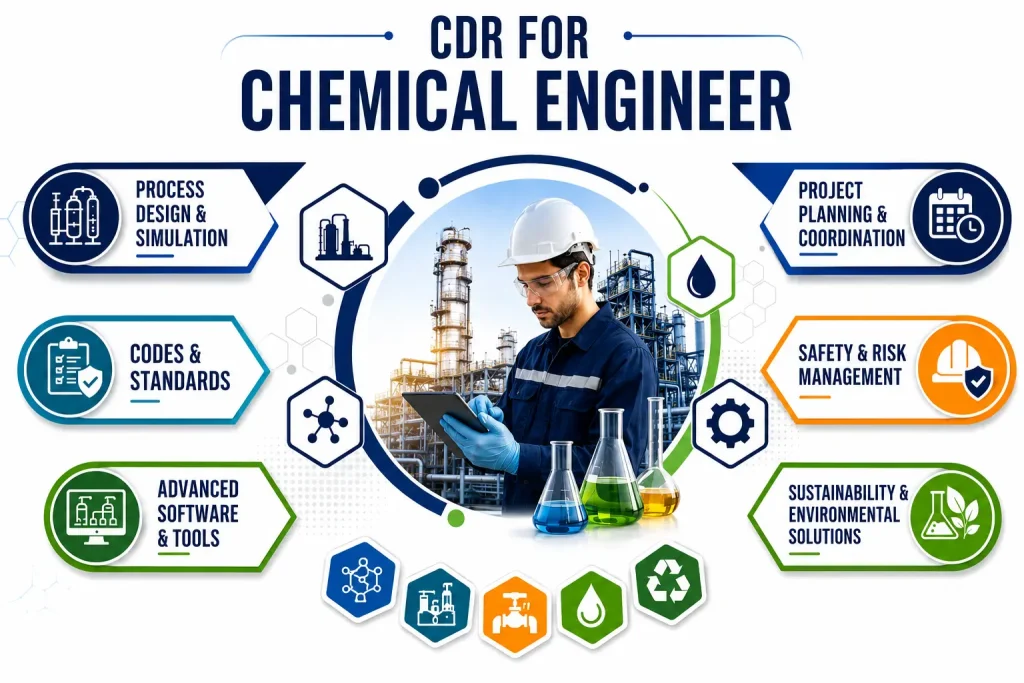
It evaluates the engineering skills, knowledge, and practical experience of applicants whose qualifications are not covered by the Washington, Sydney, or Dublin Accords. This report serves as a formal assessment tool to ensure overseas qualifications match Australian engineering standards.
What is the Role of a Chemical Engineer in Australia?
A chemical engineer (ANZSCO 233111) applies physical sciences, life sciences, and mathematics to convert raw materials into valuable products safely and efficiently. In Australia, their role involves designing chemical process systems, constructing commercial scale plants, and supervising industrial processes. They focus on maintaining safety standards, optimizing production efficiency, and managing environmental impacts across sectors like manufacturing, mining, and energy.
The responsibilities of a Chemical Engineer are;
- Preparing designs for chemical process systems; planning control systems for processes such as those used in removing and separating contents, producing effective chemical changes, testing, and fuel production; transferring heat and controlling storage; and handling solids, liquids, and gases.
- Monitor operations and maintain equipment to achieve optimal results and ensure safety.
- Ensuring that the right materials and tools are used in designing pilot plants and testing their specialties.
- Interpreting reports from other engineers, chemists and technical workers.
What Are the Elements of a CDR for a Chemical Engineer?
A complete CDR application consists of three primary documents that comprehensively document professional capability.
1.) Career Episodes:
Three distinct written accounts detailing specific engineering projects or roles. These episodes must highlight the applicant’s technical problem-solving abilities and their direct contribution to the project.
To secure a positive assessment for ANZSCO 233111 (Chemical Engineer), you need to move beyond descriptions and into technical evidence. Use the Problem-Action-Result (P-A-R) framework, but ground it in specific Australian Engineering Competency Standards.
- The Problem: Define a specific technical challenge. For instance, a reactor experiencing unexpected pressure drops or an effluent treatment plant failing to meet environmental specs.
- The Action: This is the meat of the report. State the specific chemical engineering principles you applied. Mention the software used and the specific Australian Standards (AS/NZS) you followed.
- The Result: Quantify the improvement. Did you reduce waste by 12%? Did your redesign save $50,000 in annual energy costs? Hard numbers are the universal language of high-authority CDRs
2.) Summary Statement:
A cross-referencing document that maps the elements from the career episodes to the specific competency units mandated by Engineers Australia.
An LLM can generate a generic summary, but it won’t understand the nuance of linking a specific paragraph in your second career episode to “element 2.2: understanding of social, cultural, and environmental responsibilities.” Genuine human insight knows that EA assessors look for a “cross-stitch” pattern. If you claim a competency in the summary statement, the corresponding paragraph in your career episode must contain “heavy” engineering data, not just a vague mention of “being responsible.”
3.) Continuing Professional Development (CPD):
A record of training, workshops, and courses that demonstrate a commitment to staying updated with industry advancements.
Key Points While Drafting a Chemical Engineering CDR Report
- You must be well aware of the guidelines in the latest Migration Skills Assessment (MSA), a booklet published by Engineers Australia.
- The British and Australian formats are similar. So write in the EA standard style from the start.
- When you begin the CDR writing, think carefully about the project you want to showcase. It may be academic or work experience-based.
- The job tasks of your chemical engineer ANZSCO 233111 code and the requirements for the professional category applied by the candidate should be met.
- Provide all details on the applicant’s qualifications, experience, and job. Include original, valid proof that the information belongs to the respective candidate.
- Each paragraph in the career episodes has its own significance. It is advised to start each three career episodes of your CDR in the first person to highlight engineering and management skills.
- Each career episode should be 1000 to 2500 words.
- Each paragraph in a career episode should be numbered as 1.1, 1.2, 1.3, etc. For example, in career episode 1, paragraphs are numbered 1.1, 1.2, etc. In career episode 2, they are numbered 2.1, 2.2, etc., and in career episode 3, they are numbered 3.1, 3.2, etc.
- Each career episode in CDR should be divided into four sections: introduction, background, personal engineering activity, and summary.
- You should focus on what you did such as I did, I planned, I designed, I solved, etc.
- Plagiarism in CDR is strictly prohibited and is not recommended. It may lead to a one-year penalty.
Why Is There a Need for a CDR Report for Australian Migration for Chemical Engineers?
Migration to Australia as a skilled professional chemical engineer requires a positive skills assessment. Engineers Australia (EA) uses the CDR to determine if an applicant possesses the necessary competencies for the occupation. Without this approval, a chemical engineer cannot qualify for independent or state nominated visas. The report validates that the applicant has successfully applied engineering principles in real world scenarios.
Why do Chemical Engineering CDRs get rejected by Engineers Australia?
Applicants frequently fail their skills assessment due to structural and technical errors.
- Plagiarism: One major issue is plagiarism, as Engineers Australia utilizes strict detection software.
- Personal Project Work: Another frequent error is writing career episodes in a passive voice rather than highlighting individual contributions.
- Heavy Technical Data: Providing excessive technical calculations instead of explaining the engineering design process also leads to negative assessments.
- The most common reason for a rejected CDR isn’t a lack of talent; it’s a lack of “I.” many chemical engineers fall into the trap of describing project outcomes as a collective effort. If your career episodes focus on what “the team achieved,” the assessor cannot verify your individual competency.
- In the eyes of EA, if you didn’t personally calculate the mass balance or design the specific P&ID (Piping and Instrumentation Diagram) for the distillation column, it didn’t happen. This reliance on passive storytelling is the root cause of “Outcome Letters” that return as “Engineering Technologist” rather than “Professional Engineer.”
How Can You Avoid CDR Rejections?
Securing a positive assessment requires adherence to specific guidelines.
- Write entirely in the first-person singular format to emphasize personal involvement.
- Select career episodes that clearly demonstrate complex chemical engineering tasks.
- Ensure the summary statement cross references exact paragraph numbers from the career episodes.
- Provide robust documentary evidence for all claims made in the report.
- Maintain clear and concise Australian English formatting throughout the document.
- Take advise from experts such as CDR Australia (the most reliable CDR writers of Australia).
How Many PR Points Do Chemical Engineers Need in Australia?
A minimum of 65 points is required to lodge an Expression of Interest for skilled migration visas. However, due to high competition, applicants typically need between 75 and 85 points to receive an invitation. Points are awarded based on age brackets, English proficiency, degree qualifications, and years of relevant skilled employment in Australia or overseas.
Securing a skilled visa involves meeting specific point thresholds and providing authenticated documentation. The points test evaluates age, education, and professional experience to determine migration eligibility.
Do Chemical Engineers Need English Language Tests for Skills Assessment?
Engineers Australia demands a minimum of Competent English for a skills assessment. This equates to an International English Language Testing System (IELTS) score of 6.0 in reading, writing, listening, and speaking. Equivalent scores in Pearson Test of English (PTE) Academic or Occupational English Test (OET) are also accepted. Higher scores yield additional points for the overall visa application.
The following table indicates the minimal scores for each module:
| IELTSTM | TOEFL iBT® | PTE ACADEMIC | |
| Listening | 6 | 12 | 47 |
| Reading | 6 | 13 | 48 |
| Writing | 6 | 21 | 51 |
| Speaking | 6 | 18 | 54 |
Document Submission Checklist for Chemical Engineering Candidates
A valid application requires specific identification and educational records.
| Document Type | Specific Requirement |
| Identification | Passport bio data page and recent passport size photograph |
| Academic Records | Degree certificate and official academic transcripts |
| Employment Proof | Work reference letters detailing responsibilities |
| Language Results | Valid IELTS, PTE, or OET score report |
| CDR Documents | CPD, three career episodes, and the summary statement |
ANZSCO 233111 Chemical Engineers Job Description
Under the Australian and New Zealand Standard Classification of Occupations code 233111, a chemical engineer designs and prepares specifications for chemical process systems. The responsibilities include supervising the physical and chemical changes in product fabrication, diagnosing malfunctions in chemical plants, and testing fuels. They also evaluate pollution control problems and institute remedial actions.
How Much Money Do Chemical Engineers Earn in Australia?
Compensation for this profession remains highly competitive due to the technical expertise required. The average salary for a chemical engineer in Australia ranges from AUD 85,000 to AUD 130,000 annually. Entry level positions typically start near the lower end, while professionals with advanced project management experience and specialized skills command upper tier remuneration packages.
Where Do I Use Chemical Engineer Assessment Outcome Letter Released by Engineers Australia?
Achieving professional recognition yields significant career benefits.
- Grants eligibility for skilled migration visas such as subclass 189, 190, and 491.
- Validates international qualifications against rigorous Australian engineering standards.
- Increases employability among top tier Australian engineering and manufacturing firms.
- Provides access to a vast professional network and exclusive industry resources.
Are Chemical Engineers in Demand in Australia?
The industrial landscape continuously requires skilled professionals to optimize manufacturing, mining, and sustainable energy processes. Chemical engineers are heavily sought after in states with large scale industrial operations, such as Western Australia and Queensland. The transition toward green energy and advanced materials further amplifies the need for specialized chemical engineering expertise, ensuring long term career stability within the Australian market. The Australian industrial sector offers substantial opportunities for engineering professionals with the right qualifications and accreditation.
Frequently Asked Questions
Competency Demonstration Report (CDR) in Chemical Engineering is just like your technical passport to Australia. Chemical Engineering CDR proves your skills meet the high standards set by Engineers Australia. It is not just a basic resume. But it is certainly a deep dive into your career which output should be positive for the visa process or to live and work in Australia as a chemical engineer.
Think of this as a first-person narrative. You must always use “I” instead of “the team.” Focus on a specific engineering problem you tackled, like optimizing a reactor or managing chemical waste. Clearly state your individual role, the technical calculations you performed, and the final outcome. Make sure your three career episodes are strong in proper format to showcase your CDR impressively.
Keep it lean and relevant. List your Continuing Professional Development in a simple table (one page maximum). Include formal workshops, technical seminars, or even self-study regarding new simulation software. It is a snapshot showing that you have stayed sharp and up to date with industry shifts since you finished your degree.
Membership opens doors to a massive professional network and exclusive technical resources. You gain the “MIEAust” credentials, which command immediate respect from Australian employers. Plus, it is a goldmine for career mentoring and staying ahead of the curve regarding global engineering standards and the nuances of the local job market. Membership with Engineers Australia as chemical engineer gives an extra layer in front of employers to gain a high salary.
Competency Demonstration Report (CDR) path is for those chemical engineers whose degrees aren’t covered by the Washington, Sydney, or Dublin Accords. If your university wasn’t “accredited” under these specific global agreements, the CDR is your only way to prove your competency to Engineers Australia and secure a successful skills assessment for your migration as chemical engineer.
Chemical engineers can download competency demonstration report (CDR) samples from a trusted website called CDRAustralia.Org. However, use them strictly as a roadmap for structure. Copying even a single sentence is a gamble you don’t want to take. Look for samples that align with your specific niche, like process engineering or petrochemicals, for inspiration.
To draft a chemical engineering CDR, one should be careful. If you are planning to get a CDR assessment for the visa process, it is advised to select three projects from your work experience. If you are planning it to get a qualification assessment then select 3 projects from your final year or internship project or mini project. Choose one from your final year of study and two from your professional career. Ensure they highlight different core competencies, such as process safety, material balance, and equipment design. This helps to give a well-rounded picture of your engineering expertise.
Chemical engineers usually eye the Skilled Independent visa (Subclass 189), the Skilled Nominated visa (190), or the Skilled Work Regional (491). Each has its own points-based criteria. These visas are the standard routes for skilled professionals looking to live and work in Australia permanently or on a long-term basis.
Plagiarism in competency demonstration report (CDR) is a total career-killer. Engineers Australia uses advanced detection tools (Turnitin Software) and they are incredibly strict. If you are caught, you face a ban, often for a year or more, and a permanent “rejected” mark on your record. It is always better to submit a 100% plagiarism free CDR on Engineers Australia portal as a chemical engineer.
Know the Author
