IPENZ stands for The Institution of Professional Engineers New Zealand, and after 2017, it was renamed Engineering NZ. It serves as a prominent membership body and plays a specific role in one of the most important businesses in which New Zealand is involved. Engineering NZ works as a team and plays a useful role in developing and improving the state of engineering. Hence, their primary goal is to make engineering a competent and trustworthy profession.
The Engineering NZ assessment is a formal evaluation framework designed to verify the technical competence and qualifications of professional engineers in New Zealand. As the appointed registration authority under local legislation, Engineering New Zealand ensures that practicing professionals meet standard industry benchmarks. This regulatory mechanism protects public safety, maintains engineering standards, and assists Immigration New Zealand in evaluating skilled migration applications.
The evaluation process divides into two distinct types of assessments based on the career stage and educational background of the engineer. These assessments serve separate regulatory and professional development functions.
Note: If your university is accredited by the Washington Accord, you would need KA01; if not, you would need KA02.
Categorisation of Assessment Types
Individuals seeking validation from the professional body must undergo either a Knowledge Assessment or a Chartered Professional Engineer (CPEng) Assessment, depending on their entry credentials and professional experience.
Engineering NZ Knowledge Assessment
A Knowledge Assessment functions primarily as an educational equivalence evaluation. This process determines whether an overseas qualification aligns with the standard of a four-year Bachelor of Engineering (Honours) degree accredited under the Washington Accord.
The evaluation is critical for professionals graduating from non-accord tertiary institutions. Applicants must demonstrate their technical grasp across eight foundational fields of knowledge.
- Natural Sciences Knowledge: Understanding of physics and physical principles governing engineering systems.
- Mathematical Knowledge: Proficiency in advanced mathematics, calculus, and linear algebra to model complex engineering dynamics.
- Engineering Fundamentals: Comprehensive understanding of core disciplinary concepts and underlying mechanics.
- Specialist Engineering Knowledge: Mastery of highly specific domain technicalities and advanced engineering methodologies.
The remaining four areas focus on practical design, execution, social impact, and research-driven study to confirm the applicant can conceptually handle unscripted industrial problems.

Engineering NZ CPEng Assessment
The CPEng Assessment is a competency-based evaluation for experienced engineers seeking a protected professional title and statutory recognition. Unlike a basic qualification check, this registration process measures the capacity of an individual to practice independently to a reasonable professional standard.
Securing CPEng status indicates an engineer can safely manage complex engineering activities and design solutions for complex problems. It requires a baseline of four to six years of practical experience, with significant exposure to local conditions.
| Feature Component | Knowledge Assessment | CPEng Assessment |
| Primary Focus | Academic and theoretical equivalence. | Practical competency and professional practice. |
| Eligibility Target | Non-Washington Accord degree holders. | Washington Accord degree holders or those who cleared a Knowledge Assessment. |
| Key Output | Prerequisite eligibility for registration. | Protected title, public registry listing, and sign-off authority. |
| Validity Period | Permanent qualification validation. | Requires mandatory reassessment at least every six years. |
Core Competency Groupings for Professional Charter Credential
The CPEng evaluation relies heavily on an evidence portfolio mapped against four fundamental competence groupings established by the regulatory body.
- Engineering Knowledge: Demonstrating the comprehension and practical application of advanced engineering principles specific to the local regulatory environment.
- Technical Solutions: Exhibiting the capacity to identify, investigate, formulate, and design solutions for complex engineering problems.
- Managing Engineering Work: Proving accountability, risk management, and leadership during execution phases of complex engineering projects.
- Professional Acumen: Committing to the CPEng Code of Ethical Conduct, health and safety obligations, and ongoing professional development.
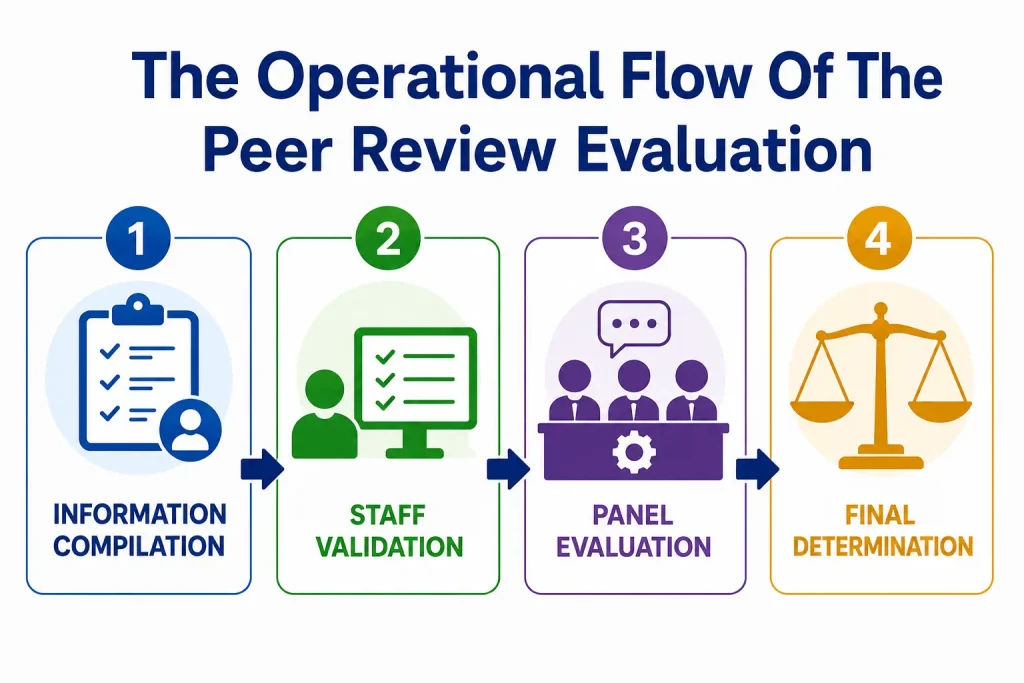
The registration authority coordinates a structured validation process for both assessment paths using specialized evaluation groups.
Final Determination: The panel submits an official recommendation to the Competence Assessment Board, which makes the final registration or equivalency decision.
Information Compilation: Candidates upload employment logs, ongoing training records, validated reference forms, and comprehensive work samples to the digital portal.
Staff Validation: A competence assessment advisor reviews the files within ten business days to ensure compliance with filing rules before forwarding the case.
Panel Evaluation: A designated panel of peer engineers reviews the application reports, interviews the candidate directly, and assigns specific technical tasks if required.
Why to Choose CDRAustralia.Org for Engineering NZ Assessment Support?
CDRAustralia.Org provides support for Engineering NZ skills assessment for NZ immigration or to become charter professional engineer (CPEng). Over 20,000 officials with an interest in engineering, sufficient knowledge, and professional engineer status are members of this organisation. This organisation is a not-for-profit. Candidates and applicants who wish to migrate to New Zealand must possess the skills and competencies required by the assessing body assessment for immigration. Our experienced writers are experts in the Engineering New Zealand Assessment.