A knowledge assessment (KA02) is a formal evaluation process used to determine whether an engineer has acquired a level of technical understanding equivalent to a Washington Accord-accredited degree. In New Zealand, a four-year Bachelor of Engineering (Honours) serves as the benchmark qualification for professional registration. When an applicant holds an unaccredited degree, a combination of overseas qualifications, or substantial work experience, they must demonstrate equivalent knowledge to be eligible to apply for status as a Chartered Member (CMEngNZ) or a Chartered Professional Engineer (CPEng).
This assessment functions as an educational bridge. The evaluation confirms that an applicant possesses the foundational engineering principles necessary to solve complex engineering problems before they proceed to a full competence assessment.
Preparing KA02 is somewhat difficult and time-consuming. It also requires more skills. To write a successful assessment, one should have Engineering experience, English proficiency, and subject knowledge.
Read Related Link: Engineering New Zealand Assessment
As more people are willing to move to NZ nowadays, there is substantial competition for securing a successful KA02 in engineering. Every Year, even qualified engineers are not eligible to move to New Zealand under the reduced assessment.
If Washington Accord accredits the University,
✔ You Need KA01 Assessment,
And If Not,
✔ You Need KA02 Assessment.

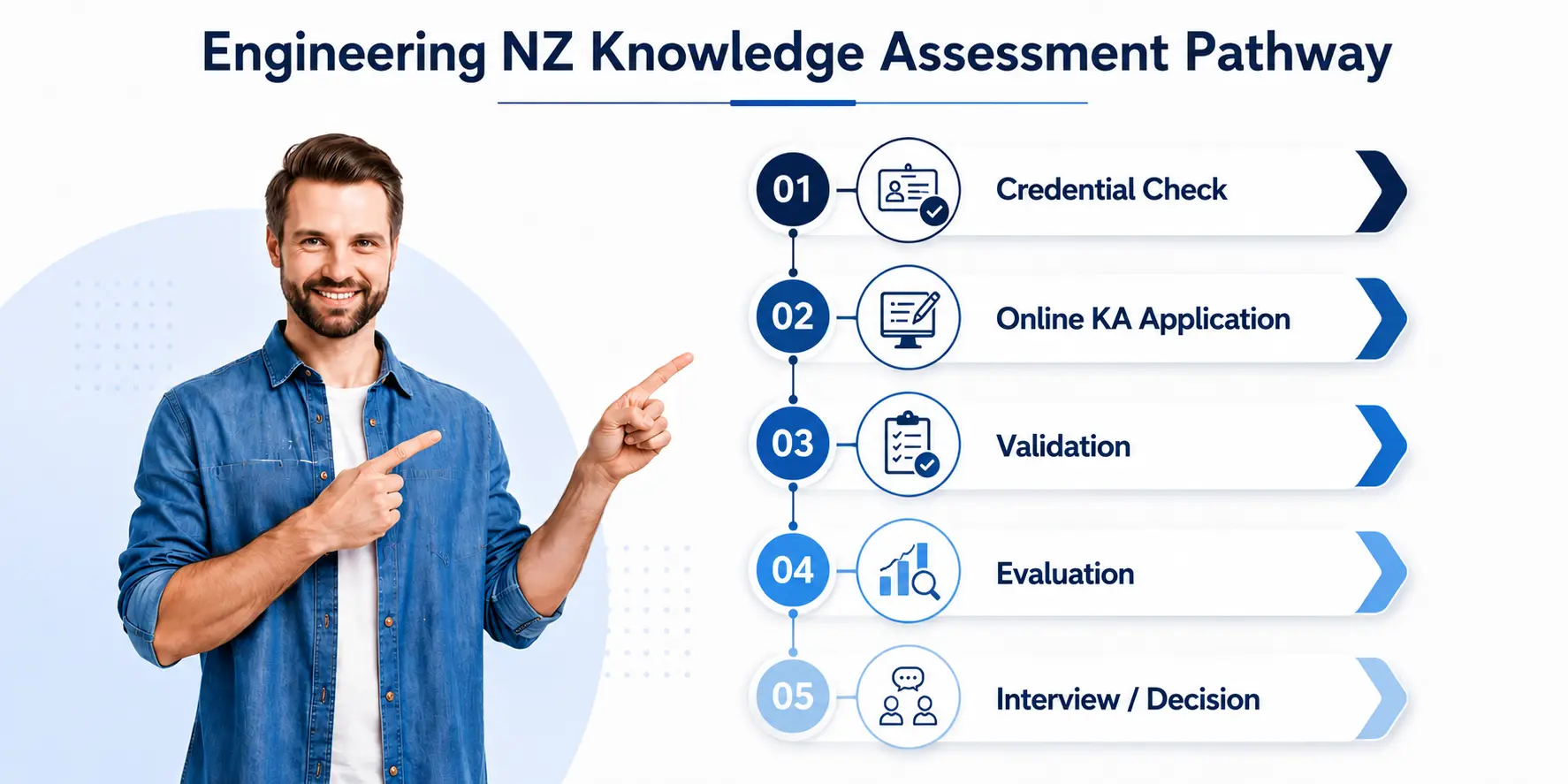
Engineering NZ Knowledge Assessment Pathway
The evaluation framework adapts to the intent of the applicant, offering distinct routing options based on immigration requirements and registration timelines. Every application begins with an initial credential check conducted by the Registration Authority to verify whether the existing qualification falls under an internationally recognized accord. If the qualification is not recognized, the applicant must select an assessment pathway.
The standard pathway processes applicants who seek long-term professional registration within New Zealand without external deadlines. Conversely, the fast-tracked pathway accommodates individuals who require formal validation specifically to satisfy Immigration New Zealand visa criteria, certifying that the applicant meets the educational benchmark required for professional practice.
Executing a Knowledge Assessment 02 Pathways
Knowledge Assessment pathway is designed specifically for engineers who do not hold a Washington Accord-accredited qualification but have built equivalent technical capabilities through a blend of alternative education, targeted professional development, and extensive on-the-job engineering practice. This pathway shifts the focus from academic credentials to verifiable engineering outcomes, requiring the applicant to present clear evidence that their professional experience has bridged any initial educational deficits.
To succeed under the Knowledge Assessment pathway, candidates must systematically compile and present a portfolio that addresses key areas of technical competence. The application relies heavily on the quality of engineering work samples and a detailed analytical commentary.
- Work Samples: Applicants must provide actual engineering documents, such as design calculations, technical reports, drawings, or research papers, that demonstrate personal involvement in resolving complex problems.
- Text Commentary: A reflective narrative must accompany the samples, explaining the engineering principles applied, the mathematical or scientific theories utilized, and the justification for specific technical decisions.
- First-Person Validation: Documentation must be written in the first person (using “I” or “me”) to explicitly define the individual contributions of the applicant rather than the achievements of a project team.
Technical Elements of the Knowledge Portfolio
The assessment evaluates candidates against specific educational components that mirror an accredited honors degree curriculum. The core of the portfolio rests on proving advanced analytical abilities and a deep understanding of natural sciences, mathematical models, and engineering fundamentals.
| Evaluation Element | Portfolio Requirements | Evidence Type |
| Mathematical and Scientific Principles | Application of advanced mathematical models, numerical analysis, and physics laws to engineering systems. | Calculations, simulations, and algorithmic formulations. |
| Engineering Discipline Fundamentals | Systematic use of specific domain knowledge to predict system behaviors or failure modes. | Design methodologies, material stress analysis, or fluid dynamics reports. |
| Complex Problem Analysis | Identification, formulation, and resolution of unstructured, open-ended engineering problems with conflicting constraints. | Root-cause analysis, risk matrices, and comparative option evaluations. |
Portfolio Submission and Evaluation Mechanics
Submitting a completed portfolio initiates a multi-stage review process managed by competence assessment advisors and specialized technical panels. The timeline spans several weeks, requiring active engagement from the applicant if clarifications are sought.
The portfolio is first reviewed during an initial validation phase to ensure all required work samples, referee declarations, and continuing professional development (CPD) logs are present. Once verified, the file is transferred to an engineering assessment panel with expertise matching the specific practice field of the candidate. This panel conducts a rigorous desktop evaluation over an eight-to-ten-week period, which frequently includes an interactive interview to probe the technical depth of the work samples provided.
The final determination outlines whether the candidate has established educational equivalence. A positive outcome updates the profile of the applicant, permitting them to formally lodge an application for full Chartered Professional Engineer registration.
Why to Choose CDRAustralia.Org for Engineering NZ KA02 Report Preparation?
Engineering NZ’s specified guidelines are very clear about the elements that must be included in the KA02 Report. One has to understand the complex engineering problems. Language skills are essential for engineers abroad. Preparing the KA02 report requires excellent communication skills. The documents must be grammatically correct. Engineering NZ has strict rules regarding skill assessments and competence assessment process is proof-based. Every Engineer has to submit work records, email correspondences, or files they worked on. If one doesn’t have files, one has to prepare essentially from scratch.
Read Related Link: KA02 for New Zealand Immigration
Besides the grammatical sense, the report should again have calculations, charts, and sections related to work episodes. People should include 1-4 episodes in the KA02 Report. Being aware of technical skills and knowledge is necessary.
People can also get a reminder email six months before the assessment date. If one is not able to send the report within that time, they are responsible for the inquiry. It is better to submit the KA02 Report before the VISA Application.