Many engineers aspire to go to Australia and settle down, and this is a dream shared by engineers worldwide. The first step towards this is preparing a convincing CDR for a structural engineer (ANZSCO 233214), which must be submitted to Engineers Australia (EA). Competency Demonstration Report (CDR) for structural engineers is intended for candidates who hold engineering qualifications.
It could be either non-accredited or obtained from countries that are not signatories to international engineering agreements. This includes the Sydney Accord, Washington Accord, or Dublin Accord. This pathway allows structural engineers to demonstrate that their foreign academic credentials and professional experience meet the stringent engineering standards in the Australian workforce.
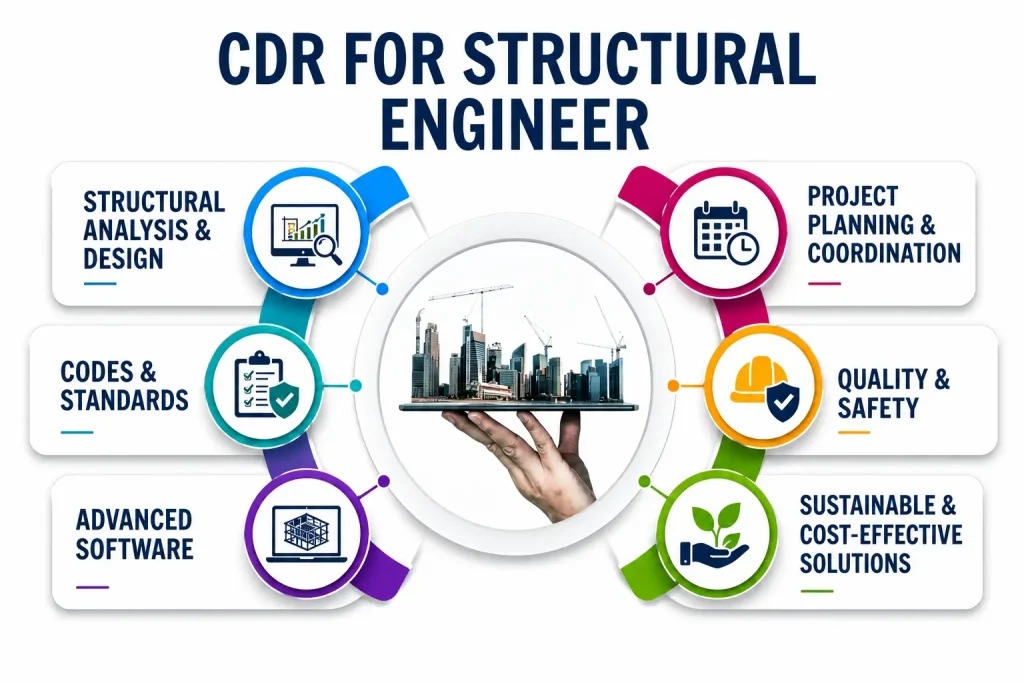
Who is a Structural Engineer in Australia?
A structural engineer is identified under the ANZSCO code 233214, and this professional role involves analysing the statical properties of structures. They also test the behaviour and durability of construction materials. The role involves designing and supervising the formation of buildings, bridges, etc. To migrate to Australia under this category as a skilled professional, applicants must obtain a successful Migration Skills Assessment (MSA) from Engineers Australia.
Purpose of the CDR Skills Assessment for Australia Migration
A positive CDR skills assessment is required by the Department of Home Affairs to ensure that migrating structural engineers possess skills similar to those of an Australian graduate. A successful CDR enables eligibility for several critical visa subclasses, including the –
- Skilled Independent Visa (Subclass 189)
- Skilled Nominated Visa (Subclass 190)
- Skilled Work Regional Provisional Visa (Subclass 491)
It acts as a benchmark verification tool for the points-tested migration framework.
Key Elements of a CDR Report for Structural Engineers
The CDR application relies on documentation that showcases both theoretical knowledge and practical engineering competencies. Engineers Australia evaluates candidates based on distinct elements that must be drafted in accordance with the official MSA guidelines.
1.) Three Career Episodes: It includes the independent essays focusing on specific periods of engineering activity or distinct projects that validate the application of engineering knowledge.
2.) Summary Statement: A single consolidated matrix that cross-references the specific paragraphs within the career episodes to the structural engineering competency elements required by Engineers Australia.
3.) Continuing Professional Development (CPD): It is a structured list in a tabular format that details the learning activities undertaken after graduation to remain current in structural engineering practices. This section must not exceed one A4 page.
Structural Engineer Job Responsibilities in Australia
A Structural Engineer analyses the static properties of structures and buildings, scrutinizes the performance and sturdiness of the materials involved in their construction, and oversees the erection of all types of buildings. Registration or licensing may also be needed.
Skill Level: 1 – UNIT GROUP 2332
Key Tasks Include:
- Defining the construction methods, tools, materials, and their quality criteria, stipulating and inferring their specifications, drawings, planning, construction methods, and techniques.
- Systematizing and guiding the site labor and delivery of the construction equipment and materials, and laying down the thorough sequences for successful coordination of construction activities.
- Obtaining the samples of soil and rocks at various depths at the sites for testing to govern the strength, compressibility, and other deciding factors which may affect the characteristics of the land and rock when a building is erected, thus determining the sturdiness of the entire structure.
- Studying the architectural and technical drawings for evaluation of the approximate costs, and preparing detailed projections of charges to assist in the financial planning of the construction.
- Observing the changes in designs, evaluating the effects on value, and measuring the variations in the plans based on the original design.
- Examining the mechanical systems for both stagnant and dynamic loads.
- Designing the buildings to ensure they are sturdy and do not collapse, stoop, or vibrate during undesirable situations.
- Evaluating the present and future patterns of travel, keeping in mind the increase in the population, and working on the necessary changes accordingly.
- Designing and planning the physical features of transportation systems, like the highways, railways, airways, logistic supply systems, and their depots.
Required Steps to write a top-notch, strong CDR for Structural Engineer?
Preparing a high-quality Competency Demonstration Report (CDR) is essential for structural engineers seeking professional recognition. Below are the key steps to ensure your CDR meets industry standards and effectively demonstrates your expertise.
Following a systematic approach during CDR preparation ensures that all technical components of the assessment align with administrative expectations. Preparing the report requires careful selection of project histories and meticulous documentation.
- Select Appropriate Projects: Identify 3 different engineering projects from your academic curriculum or professional history that highlight complex structural design, calculation, and problem-solving.
- Draft Career Episodes in Chronological Order: Write each episode using the first-person singular pronoun “I” to emphasise personal contribution rather than team performance.
- Map Competencies to the Summary Statement: Ensure your written narratives cross-reference the standard indicators of engineering competence.
- Compile Supporting Evidentiary Documentation: Gather employment reference letters, official academic transcripts, and official payslips to validate your claims.
Sample CDR Report for Structural Engineer (ANZSCO 233214)
The sample CDR for a structural engineer includes all the mandatory reports, such as Three Career Episodes, Continuing Professional Development (CPD), Summary Statement, and the Curriculum Vitae.
Consider an example of a structural engineer having a certain amount of experience. The following sample will clear things up a little more:
Career Episode 1: In this career episode for the structural engineer, you need to describe the first position after graduation. Here, you might be responsible for all construction work on the site. You are supposed to monitor the labourers and ensure the work is done in accordance with the prescribed standards.
Career Episode 2: In this career episode, you could have participated in a more massive project. This would include site design. You would be required to supervise all on-site physical work, arrange construction materials, manage personnel, develop project sections, monitor and report on the project’s financials, and more.
Career Episode 3: Here, you would oversee a major segment of a large project. Your key responsibilities would include making project-related decisions, collaborating with professionals, supervising on-site construction activities, and managing the workforce.
CDR Summary Statement: Here, all the competencies required of a Professional Engineer are outlined. There is a cross-reference to the relevant parts of the career episodes, as elucidated by the Engineers Australia norms.
How Structural Engineering CDRs End Up Rejected: A Common Scenario
Acknowledging the main reasons for application rejection can help candidates avoid risks before submitting their documentation to Engineers Australia.
- Utilising online templates, paraphrasing tools, or content from previously submitted applications results in immediate rejection and potential bans of up to 36 months.
- Excessive Focus on Group Achievements by choosing to write in a collective tone by using terms like “our team calculated” or “we designed” instead of explicitly highlighting personal actions.
- Absence of Engineering Calculations in career episodes that do not have numerical evidence, mathematical design checks, or reference to structural software tools. These fail to demonstrate professional competence.
Note: A positive skills assessment provides the legal foundation for entering the SkillSelect system. Without an official outcome letter from Engineers Australia, an applicant cannot submit an Expression of Interest (EOI), the primary gateway to receiving an invitation to apply for permanent residency.
Required Points for Australia Migration as Structural Engineers
The table below outlines the standard allocation of migration points relevant to points-tested visa subclasses. Applicants must achieve a minimum baseline score of 65 points to remain eligible for visa consideration.
| Criteria Category | Specific Sub-Category | Points Allocation |
| Age brackets | 18 to 24 years | 25 points |
| 25 to 32 years | 30 points | |
| 33 to 39 years | 25 points | |
| Overseas Work Experience | 3 to 4 years | 5 points |
| 5 to 7 years | 10 points | |
| 8 to 10 years | 15 points | |
| Educational Qualification | Bachelor’s or Master’s Degree | 15 points |
| Doctoral Degree (PhD) | 20 points |
Document Checklist Along With CDR Submission
A complete submission requires a meticulous arrangement of primary and secondary evidence to facilitate verification by the assessing officer.
- A current valid passport biodata page along with recent passport-sized colour photographs.
- An official degree certificate accompanied by complete academic transcripts from the awarding university.
- A certified curriculum vitae mapping out complete employment timelines and responsibilities.
- Formal employment reference letters printed on company letterheads with job descriptions.
- Evidence of paid employment, including tax return documentation, bank statements, and Social Security payments.
English Language Proficiency Requirements
Engineers Australia mandates specific baseline scores across international English language testing platforms to confirm communication adequacy in professional environments.
- IELTS Academic or General: A minimum score of 6.0 in each of the four modules: Listening, Reading, Writing, and Speaking.
- PTE Academic: A minimum score of 50 in each of the four components.
- TOEFL iBT: Minimum scores of 12 for listening, 13 for reading, 21 for writing, and 23 for speaking.
Tests remain valid for three years from the test date up until the time of assessment submission.
Note: Passport holders from the United Kingdom, the United States of America, Canada, New Zealand, and Ireland are exempt from providing these language test results.
Salary Structure for Structural Engineers in Australia
The remuneration for structural engineers in Australia is highly dependent on experience and geographical location.
Graduate or junior structural engineers – AUD 70,000 and AUD 85,000 yearly.
Mid-level professionals with four to seven years of experience – AUD 95,000 to AUD 120,000.
Senior or Principal Structural Engineers – AUD 140,000.
Financial Costs and CDR Processing Timelines
The standard fee for a CDR pathway assessment is approximately AUD 945, though it may vary. This excludes any additional services such as relevant skilled employment or PhD qualification assessments.
Moreover, standard processing timelines can range from 8 to 12 weeks after payment. Applicants can choose fast-track processing services by paying an additional premium, which reduces the initial review timeframe to approximately 15 working days (Fast Track Service).
Is There a High Demand for Structural Engineering in Australia?
The National Skills Commission lists Structural Engineers on the MLTSSL (Medium and Long-term Strategic Skills List). Noteworthy investments in urban high-rise developments, major civil infrastructure, and regional transit systems across Australia are addressing a long-term shortage of qualified structural professionals, ensuring a high rate of visa sponsorship and permanent residency invitations for skilled offshore candidates.
Why Choose CDRAustralia.Org for CDR Australia Migration
CDRAustralia.Org stands as the leading choice for engineers seeking expert help with their competency demonstration reports (CDR). Our team is made up of accomplished professionals who have excelled in their engineering fields, successfully passed the EA assessment, and landed rewarding careers in Australia. We guide candidates from every engineering branch to craft outstanding CDR reports. Connect with our top writers today and take the next step toward your engineering future.
Frequently Asked Questions (FAQs)
A Competency Demonstration Report (CDR) for structural engineers is a technical portfolio used by Engineers Australia to assess the skills and knowledge of engineers whose qualifications are not recognized under the Washington, Sydney, or Dublin Accords. It proves your engineering competency meets Australian professional standards for migration.
The ANZSCO code for a Structural Engineer is 233214. This code falls under the Civil Engineering Professionals unit group and is used by Jobs and Skills Australia and Engineers Australia for classification, skill assessment, and migration purposes in Australia.
The purpose is to allow applicants with non-accredited or overseas qualifications to demonstrate that their engineering knowledge and professional competencies are equivalent to Australian standards, facilitating a Migration Skills Assessment for a skilled visa.
No, A CDR is specifically for the Migration Skills Assessment. Membership entry usually depends on your qualification’s accreditation status. However, if your degree is non-accredited, a CDR-style assessment may be required to prove eligibility for certain membership grades.
You can download CDR samples for structural engineers from Australian reputed and trusted websites named CDRAustralia.Org. Their samples can help you understand the requirements better so that you can craft a CDR that actually works.
An Engineering Technologist assessment for structural engineering requires a minimum of a three-year Australian Bachelor of Technology degree in engineering, or an equivalent overseas qualification, focusing on applicable engineering techniques and methods.
A Professional Engineer assessment requires a four-year Australian Bachelor of Engineering degree (or a five-year Master’s) or a recognized equivalent overseas qualification following 12 years of primary and secondary schooling.
First, obtain a Positive Skills Assessment from Engineers Australia. Then, submit an Expression of Interest (EOI) through SkillSelect for points-tested visas such as the Subclass 189, 190, or 491, ensuring you meet the age, English, and points requirements.
The most common mistake is plagiarism (including using AI or templates). Other errors include describing “team” achievements instead of individual contributions (using “we” instead of “I”) and failing to include specific technical calculations or structural design evidence in the Career Episodes.