Joining Engineers Australia (EA) connects you directly to national registration benchmarks, professional indemnity credibility, and a network of technical colleges across Australia. You need an accredited qualification matching national benchmark requirements, or an equivalent skill assessment verifying your Stage 1 competency.
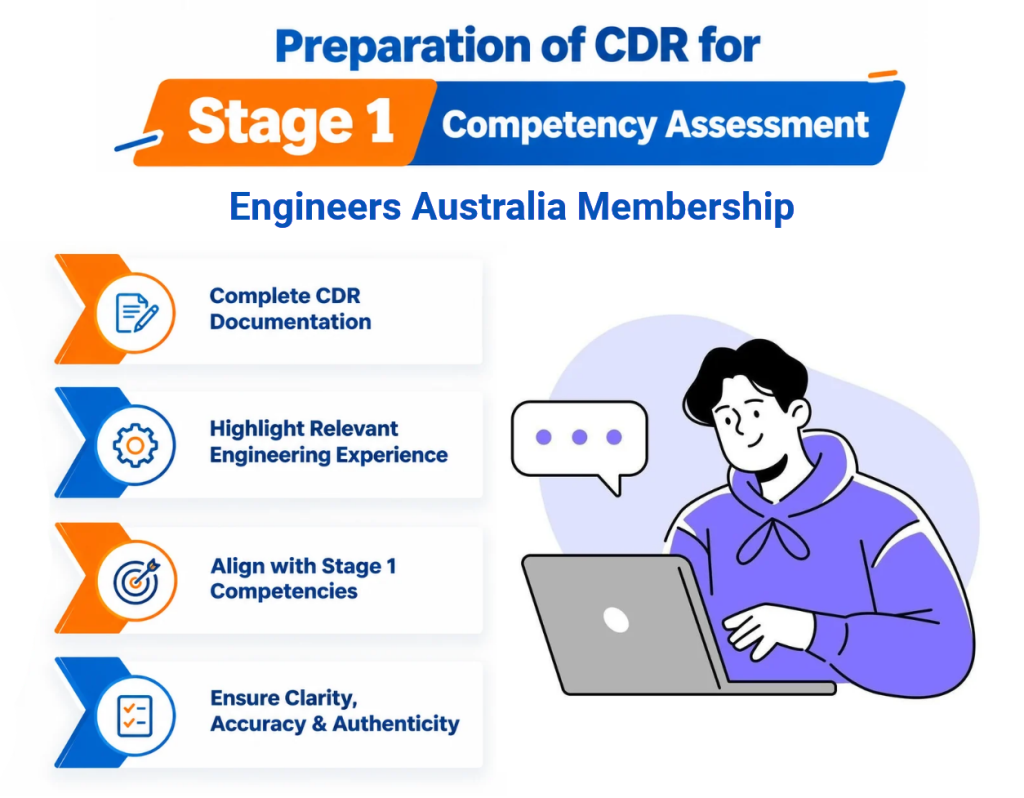
If you are planning to get membership with Engineers Australia (EA), then you must go through the CDR Stage 1 competency assessment conducted by EA and then you get eligibility to become a member. CDR stands for Competency Demonstration Report, a lengthy, technical report. It takes time and effort to prepare well-structured three career episodes, a summary statement, and CPD (continue professional development) as per assessing body compliance.
Stage 1 competency is for those migrant engineers whose engineering qualification is not recognized by EA. Let me explain with an example
- Candidates having degree in engineering not approved by EA but may have graduate degree in engineering.
- If you have an Australian engineering degree but its not approved by engineers Australia.
- A migrant engineer (overseas) with an engineering degree is not recognized by EA.
What is Stage 1 Competency Assessment?
Stage 1 Competency Assessment is Engineers Australia’s process for determining whether an applicant has the knowledge, engineering ability, and professional attributes required to enter practice as a qualified member of the Australian engineering team. It is generally demonstrated through an accredited or EA-recognised engineering qualification, but applicants whose qualifications are not automatically recognised may need to submit supporting evidence, including career episodes and a summary statement.
Stage 1 competency has three broad components: Knowledge Base, Engineering Ability, and Professional Attributes. The assessment is holistic, meaning EA considers your qualifications and experience together rather than requiring every individual indicator to be separately evidenced.
Engineering Occupation Categories
Engineers Australia has three engineering categories
- Professional engineer :- Four year bachelor engineering degree or five year of master engineering.
- Engineering technologist :- Three year of bachelor engineering or bachelor of science degree.
- Engineering associate :- Two year advanced diploma or associate degree in engineering field.
Required Document
For a stage 1 competency assessment application, EA expects supporting documents to be uploaded, preferably in PDF format. Scanned documents should be clear, in colour, and at least 300 dpi; individual files should preferably be under 5 MB, with a maximum of 10 MB.
The required material includes:
- Passport-size photograph.
- Photo identification, such as a passport bio-data page or Australian driver’s licence.
- A verified Curriculum Vitae covering your complete employment history since undergraduate study.
- Evidence of English language competency.
- Qualification documents, including testamurs and academic transcripts, with certified English translations where applicable.
- Three career episode reports demonstrating how you developed and applied Stage 1 competencies.
- A Summary Statement mapping your career episodes to the competency elements for your nominated occupational category.
Your CV should be no more than three A4 pages and must cover your engineering employment from the completion of your undergraduate studies to the present. It should include employer details, employment dates, job title, role, and responsibilities; verification is required for at least the last three years of engineering employment, or for the full period if you have less than three years’ experience.
Mandatory Requirements
EA requires applicants to demonstrate adequate underpinning engineering knowledge, usually obtained through an initial engineering qualification. Candidates with non-engineering or engineering-related qualifications should note that work experience alone may not be sufficient to bridge a significant shortfall in foundational engineering knowledge; additional formal education may be required.
Difference between Stage 1 and Stage 2 Competency Assessment
Stage 1 competency is the entry-level standard required for eligibility for EA membership. It confirms that you understand the relevant engineering knowledge base and can apply it to representative engineering problems and situations.
Stage 2 competencies, by contrast, is the standard expected of an experienced engineering practitioner and is required for Chartered membership of Engineers Australia. Stage 2 focuses on independent professional practice, leadership, and advanced engineering judgment, and it is assessed separately from the Stage 1 membership eligibility process.

| Aspect | Stage 1 Competency Assessment | Stage 2 Competency Assessment |
| Purpose | Eligibility for EA membership | Chartered membership |
| Career level | Entry to professional engineering practice | Experienced practitioner |
| Focus | Engineering knowledge, application ability, and professional attributes | Independent practice, leadership, and advanced professional capability |
| Typical evidence | Accredited qualification or application with career episodes and summary statement | Separate Stage 2 assessment process |

Eligibility Pathways to Achieve Membership
Your entry route depends on where and how you completed your formal studies. EA verifies that your foundation knowledge aligns with stage 1 competency standards across theory, application, and ethical practice.
Pathway1: Recognised Australian Qualifications
Graduating from an EA-accredited programme gives you automatic eligibility for graduate or full member grades. The university programme must appear on the published list of accredited courses for your graduation year.
Pathway2: International Engineering Alliance Accords
Professional engineering bodies in several other nations have Mutual Recognition or Mutual Exemption Agreements with Engineers Australia. You might be eligible to apply for membership in Engineers Australia if you are a member of an engineering organization with whom Engineers Australia has a mutual recognition agreement.
International degrees receive recognition if your tertiary institution was accredited under one of three International Engineering Alliance accords:
- Washington Accord: For professional engineers.
- Sydney Accord: For engineering technologists.
- Dublin Accord: For engineering associates.
Your degree must be completed within a signatory jurisdiction during or after the year the country achieved full signatory status.
Pathway3: Mutual Recognition Agreements
Engineers registered in specific jurisdictions (including the UK, Canada, Hong Kong, and Ireland) can apply under bilateral mutual recognition agreements. These direct arrangements bypass standard competency demonstrations if you hold full corporate status with a partner organisation.
CDR Career Episodes Requirements for EA Membership
Career episodes are the core written evidence in a stage 1 competency assessment. They demonstrate to the assessor that your engineering knowledge has been consolidated and applied appropriately to meet the Stage 1 competencies for your occupational category.
You must prepare three career episodes, each describing a significant engineering learning experience—such as a major project, design exercise, research task, or employment-based engineering activity. Together, the three episodes should cover all competency elements for your nominated category; each individual episode does not need to address every element.
How to Write Three Career Episodes to Meet EA Membership Compliance
Write each episode in the first person singular (“I designed…”, “I analysed…”, “I resolved…”), because EA needs to see your personal contribution clearly. Describe work you actually performed rather than simply listing your job responsibilities or explaining what your team or organisation did.
Each career episode should be approximately 1,500 words, and must not exceed 2,000 words. Number every career episode and every paragraph. For example, paragraph 3 of Career Episode 2 is referenced as CE2.3, so that you can cross-reference them in your Summary Statement.
For a team project, briefly explain the overall project, but focus mainly on your individual role: what you did, how it contributed to the project objective, the engineering problems you solved, and the competencies demonstrated. Formulae, tables, photographs, and drawings can support your explanation, but they cannot replace a clear description of your personal engineering activity.
What would be the Structure of a Work-Based Career Episode?
For career episodes based on engineering employment, EA expects the following structure:
Introduction
- Dates and duration of the project or appointment.
- Name and location of the employing organisation.
- Your position title.
- Background, nature, and objectives of the overall engineering project.
- Your particular work area.
- An organisation chart showing your position.
Personal Performance
- A detailed account of the work you personally performed.
- Technical details of the work.
- How you applied engineering knowledge and skills.
- Tasks delegated to you and how you completed them.
- Engineering problems encountered and the problem-solving methods used.
- Strategies you developed, including any original or creative design work.
- How you worked with other team members.
Summary
- A brief overview of the project outcome.
- Whether the project met its goals and requirements.
- How your personal contribution supported the project’s success.
What would be Career Episodes for Graduates without Work Experience?
Recent graduates who do not yet have substantial engineering employment experience may base career episodes on experiences gained during their qualification. The strongest examples are usually advanced project work, design exercises, laboratory work, research projects, or other substantial academic activities where you applied engineering knowledge in a practical context.
You should explain the most challenging aspects of the work, the knowledge and units of study that supported it, how you carried out the work, and how it demonstrates the relevant stage 1 competency. Simply stating that a subject covered certain competencies is not enough; you must describe the specific work you personally performed.
What are the Impacts of Plagiarism in Career Episodes?
Career episodes must be based on work you personally conducted and written entirely in your own words. Using templates, copied career episodes, online sources, or presenting another person’s work as your own constitutes plagiarism and can lead to CDR rejection of the application and a ban of 12, 24, or 36 months.
Application and Annual Fees
Engineers Australia membership fees vary depending on your career stage and required assessment type:
- Migration Skills Assessment: Overseas graduates without accord accreditation complete a Competency Demonstration Report (CDR) assessment before membership approval, incurring separate assessment charges.
- Direct Entry Assessment: Accord graduates pay an administrative entry fee without needing full CDR compilation.
- Annual Subscriptions: Membership subscriptions run on an annual cycle, with pro-rata rates for mid-year joiners and concession structures for recent graduates or career breaks.
How CDRAustralia.Org Supports to Achieve Membership ?
CDR Australia is a trusted CDR writing company in all engineering streams, with a team of engineers to write all three career episodes reports and the summary statement report to meet Engineers Australia membership criteria. We have delivered thousands of competency demonstration reports (CDR) to our clients, and they are working as engineers and getting good salary packages.