Those looking for a complete roadmap to ensure a successful Australian immigration must fulfil the criteria of presenting a top-notch CDR report. This Competency Demonstration Report (CDR) is a mandatory technical portfolio for engineers seeking skilled migration to Australia who do not possess qualifications accredited under the Washington, Sydney, or Dublin Accords. A successful assessment is the critical foundation for skilled migration visa applications, as it validates the equivalence of international qualifications to the Australian standard.
Managed by Engineers Australia (EA), the assessment verifies that an applicant’s competencies, technical knowledge, and practical experience align with the professional standards required to practice in the Australian engineering industry.

Core Components of the CDR for Australian PR
A CDR submission must demonstrate professional competency through specific, verifiable evidence. The report acts as a comprehensive record of your professional engineering history. The following table outlines the essential elements required for a complete CDR submission:
| Component | Purpose | Key Content |
| CPD Statement | Demonstrates commitment to ongoing learning. | List of training, workshops, and seminars attended post-graduation. |
| Three Career Episodes | Provides evidence of individual technical application. | Detailed narratives of three distinct engineering projects or tasks. |
| Summary Statement | Maps individual experience to EA standards. | References to specific paragraphs in career episodes linking to competency elements. |
| Curriculum Vitae | Profiles professional and academic history. | Chronological summary of employment and education. |
The Continuing Professional Development (CPD) record is often overlooked but remains vital. It serves to prove that you have maintained your knowledge of current engineering developments, codes, and standards in your field of expertise.
Structuring Three Career Episodes
Career episodes constitute the primary evidence of your engineering ability. Engineers Australia requires three separate narratives, each focusing on a different project or technical challenge encountered throughout your career or academic. Three projects may be your university/college final year project or mini project or internship program project or work experience based projects. These must be written in the first person singular to highlight your individual contributions, decision-making processes, and technical application.
- Introduction: Define the project title, your specific role, the duration, and the organizational context.
- Background: Describe the project objectives, the environment in which you worked, and the relevant engineering scope.
- Personal Engineering Activity: Detail the tasks you performed, the methodologies employed, the technical problems you encountered, and your solutions.
- Summary: Conclude with the project outcome, your professional achievement, and lessons learned.
Each career episode should be between 1,000 and 2,500 words. Using the active voice is essential to clearly articulate your specific involvement in technical problem-solving and design development. You must focus on your personal actions rather than the work of your team. Vague descriptions of team achievements without specifying your individual role will weaken your application.
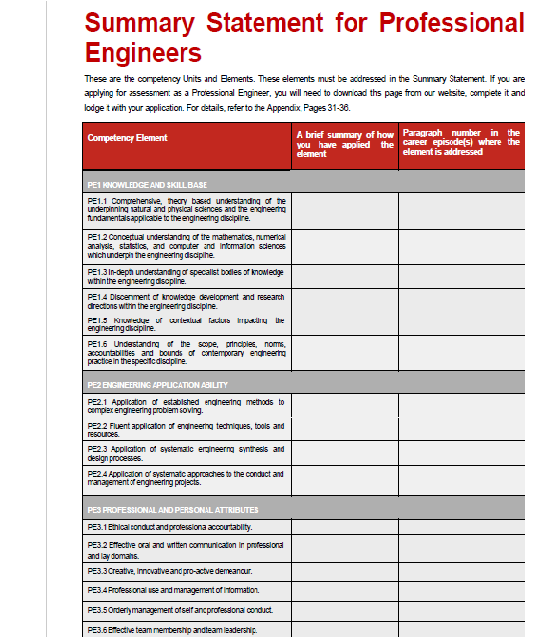
Mapping Competencies via the Summary Statement
The summary statement integrates your three career episodes by mapping them to the specific competency elements required for your nominated occupational category. These categories include
- Professional Engineer,
- Engineering Technologist (ANZSCO 233914 )
- Engineering Associate
- Engineering Manager (ANZSCO 133211 )
You must identify the specific paragraphs in your career episodes that demonstrate each competency element. If your experience does not clearly show the required competency, the application may be delayed or rejected. This document proves that your practical experience bridges the gap between your academic foundation and the professional standards of Australian engineering. You are responsible for demonstrating that you possess the complex problem-solving skills and ethical awareness expected of an engineer in Australia.
Our Amazing Features
- Australian Professionals
- Written By Human
- 100% Approval Guaranteed
- AI & Plagiarism Check Report
- Free Reworking
- 15+ Years of Experience
Essential Documentation and Submission Requirements
Beyond the narrative reports, your application must include verified documentation to support the claims made within your career episodes. Failure to provide complete, authentic records often leads to assessment failure or requests for additional information, which significantly increases processing times.
- Academic Evidence: Certified copies of degree certificates, full transcripts, and official syllabus documents.
- Professional Evidence: Signed reference letters on company letterhead detailing your duties, duration of employment, and specific roles.
- Language Proficiency: Valid results from recognized English language tests such as IELTS, PTE Academic, or TOEFL iBT.
- Identity Verification: A copy of the photo page of your current passport.
All documents must be provided in English. If your original documents are in another language, you must provide a professional, certified translation. Ensure that your employment letters include clear contact details for your supervisors, as Engineers Australia may conduct verifications.
Costs, Timelines, and Validity Rules (2026 Update)
As of 2026, Engineers Australia maintains a structured fee and timeline framework for CDR assessments. Standard assessment fees are adjusted periodically, so applicants should verify the current cost directly through the EA portal prior to payment. While standard processing times typically range from 8 to 12 weeks, these can fluctuate based on the volume of applications and the complexity of your case.
For those requiring faster processing, EA offers a “Fast Track” service for an additional fee, which can significantly reduce the wait time. Regarding validity, once you receive a positive CDR assessment outcome, the letter is generally valid for three years from the date of issuance for the purpose of migration applications. It is critical to ensure your visa application is lodged while this assessment letter is still within its validity period, as an expired assessment will not be accepted by the Department of Home Affairs.

Effect of Negative CDR Assessment on Your Visa Application
Receiving a negative assessment outcome is a major setback, but it is not necessarily the end of your migration journey. If Engineers Australia determines that your report does not meet the required standards, they will provide feedback outlining the specific areas of deficiency.
A negative result directly halts the skilled migration process because a valid, positive skills assessment is a mandatory prerequisite for submitting an Expression of Interest (EOI) or lodging a visa application through SkillSelect. If you attempt to lodge a visa application without a positive assessment, it will almost certainly be refused.
If you receive a negative outcome, you have two primary options:
- Appeal/Review: If you believe the assessment was incorrect or that the assessor overlooked evidence, you may apply for a formal review within the stipulated timeframe. This requires strong justification and, in some cases, additional documentation.
- Re-submission: More commonly, applicants use the feedback provided to address the gaps in their CDR Career Episodes or Summary Statement. Once you have strengthened your documentation to meet the competency requirements, you can re-apply.
Carefully addressing the feedback is essential, as repeated negative outcomes can be flagged. If your rejection was due to plagiarism or providing fraudulent documents, the consequences are severe, often resulting in a multi-year ban from applying for skills assessments or Australian visas.