The Summary Statement is the section where Engineers Australia checks alignment, accuracy, and professional clarity. You are not retelling your career episodes here. Engineers Australia designed a template to help you write your summary statement for professional engineers. Professional engineer summary statement is an overview of the competencies you’ve demonstrated in each of your career episodes.
You are guiding the assessor to where each competency is demonstrated. A well-written Summary Statement saves the assessor time and strengthens credibility across your entire submission.
Purpose of the Professional Engineer Summary Statement
For a Professional Engineer pathway, the Summary Statement links your career episodes to the competency elements under PE1, PE2, and PE3. Each element must clearly point to the paragraph numbers in your career episodes. Assessors expect precision, consistency, and professional logic.
This section reads more like a technical index than a narrative, yet clarity of language still matters. If references feel forced or vague, assessors question the quality of the entire CDR.
What Engineers Australia Expects in CDR Summary Statement for Professional Engineer
- Accurate paragraph references that match career episode numbering
- Clear demonstration of engineering judgement, not task repetition
- Evidence spread logically across all competency elements
- Consistent terminology between episodes and summary statements
These expectations appear simple, though execution requires close attention.
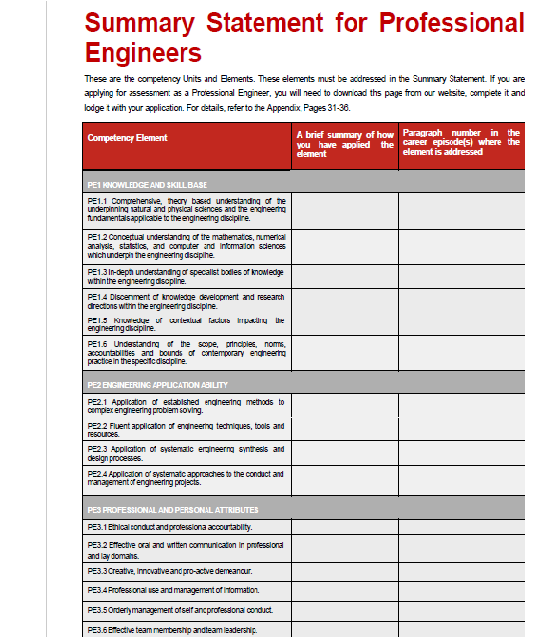
Structuring the Professional Engineer Summary Statement Correctly
Each competency element requires short, direct explanations followed by exact paragraph references. Writing too much works against you. Writing too little creates gaps. Balance comes from understanding what each element is asking.
| Competency Element | What to Reference | Common Mistake |
| PE1 Knowledge | Design methods, analysis decisions | Listing qualifications |
| PE2 Application | Calculations, problem resolution | Referring to team actions |
| PE3 Responsibility | Ethics, safety, leadership | Using generic statements |
Common Writing Errors to Avoid Summary Statement Rejections by Engineers Australia
- Many applicants reuse sentences from career episodes, thinking consistency helps. It usually creates duplication.
- Others reference paragraphs that do not actually show the claimed competency. Assessors verify every reference.
- Another issue appears when applicants mix roles across episodes. Each reference must match the episode context exactly, or credibility weakens.
Practical Writing Approach
We recommend drafting the Summary Statement after finalising all career episodes. Keep your career episode paragraphs open as you write. Read each competency element slowly, then confirm the paragraph actually proves that claim. Clarity always works in your favour.
CDRAustralia.Org Provides Professional CDR Support That Strengthens Your Summary Statement

Preparing a Summary Statement requires alignment, structure, and careful checking across every section of the CDR. Many engineers struggle with this step even after strong career episodes. CDRAustralia.Org supports applicants through detailed professional engineer summary statements required in CDR documentation.
We work with your actual engineering experience, review every reference carefully, and refine language without altering meaning. This structured support reduces assessment risks and helps present your skills clearly and confidently.