Are you looking for Overseas Qualifications Assessment from AACA Australia? Get professional help from an experienced engineer at CDRAustralia.Org to get 100% plagiarism free and unique qualities.
AACA’s Overseas Qualifications Assessment process, conducted in two stages, determines whether an individual’s overseas academic qualification compares with a current Australian accredited qualification in architecture.
Who Can Apply For AACA Registration?
To register as an architect with a state or territory architect registration board in Australia, generally applicants must have completed an Australian-accredited architectural qualification (or successfully completed the AACA’s Overseas Qualifications Assessment) before sitting the Architectural Practice Examination.
Note: If you hold an accredited architecture qualification from Australia, New Zealand, or Hong Kong, you DO NOT need to complete the Overseas Qualification Assessment. You may apply for a Skills Assessment based on the completion of an accredited architecture qualification via the Verification of Australian Qualifications process.
ANZSCO Code 232111
100% Plagiarism free & High Quality Architect Portfolio for AACA Australia
Our professional experts are highly qualified in Architect fields, working in companies in Australian and associated with our organisation to assist our candidates. We guarantee 100% approval when you get our Architectural portfolio writing services.
Eligibility: Applicants must have completed Stage 1 (irrelevant of the outcome) and be a lawful resident in Australia.
Professional Experience: Can be used in the project examples provided in the portfolio.
Outcome:
- Successful applicants are provided with a Skills Assessment letter for migration purposes (if required) and a letter that acts as an authority to enrol to complete the Architectural Practice Examination (APE).
- Unsuccessful applicants are provided written advice as to where they are deficient and how to upgrade their qualifications.
Timeframes: Applications are generally finalised within 12 weeks
How To Write Architectural Portfolio for AACA Australia?

Stage 2 completes the Overseas Qualifications Assessment. Through the submission of a project portfolio and participation in a face-to-face interview, applicants have the opportunity to demonstrate how their qualifications have equipped them with the skills, knowledge, and competencies required to
satisfactorily meet the relevant criteria of the National Standard of Competency for Architects (NSCA). This is the minimum standard required of a graduate from an accredited program of study in Australia.
satisfactorily meet the relevant criteria of the National Standard of Competency for Architects (NSCA). This is the minimum standard required of a graduate from an accredited program of study in Australia.
Each of the relevant thirty-seven (37) required performance criteria in the National Standard of Competency must be demonstrated at the level indicated, being one of the following:
- Knowledge acquisition; applicant demonstrates a clear understanding, no requirement for application or demonstration of skill.
- Skill acquisition; applicant demonstrates skill, no requirement for application in practice.
- Application of Knowledge and Skill in architectural practice: the applicant demonstrates a clear understanding and shows where they have applied it in an architectural or practice scenario.
Applicants submit a portfolio of 2-4 projects, compiled from any combination of academic and/or professional work, mapped to the National Standard of Competency for Architects Performance Criteria Checklist in a way that clearly demonstrates how the work meets the performance criteria. This is followed by an interview where applicants have the opportunity to articulate
The ways in which their academic qualification/s and portfolio of work demonstrate these competencies.
The outcome is determined by the applicant’s ability to convincingly demonstrate that they possess the competencies required to adequately meet the relevant performance criteria. Successful participants are then eligible to sit the Architecture Practice Examination (APE) for registration as an architect in Australia.
The ways in which their academic qualification/s and portfolio of work demonstrate these competencies.
The outcome is determined by the applicant’s ability to convincingly demonstrate that they possess the competencies required to adequately meet the relevant performance criteria. Successful participants are then eligible to sit the Architecture Practice Examination (APE) for registration as an architect in Australia.
Checklist of Documents Required
- Statutory Declaration
- Project Portfolio
- NSCA Performance Criteria Checklist
- Project Summary proforma
- Proof of Residency Status – either:
-
- Permanent or relevant temporary visa as issued by the Department of Immigration and Border Protection; or
- High-quality scan of an Australian Passport at the photo identification page
- Proof of English Proficiency – either:
-
- IELTS Test Certificate; or
- Employer Letter
- Evidence of Name Change (if applicable)
- Signed Authorisation Letter (if you are using an Agent)
- Evidence of Registration as an Architect in English (if applicable)
- A high-quality, colour scan of your passport
- Two (2) of the following documents in a high-quality, colour scan:
-
- Birth certificate
- Driver licence
- National ID card
- Social security card
- Student ID card
- Marriage certificate
- Official photo bearing document
- Access to the web portal of your English language test results
- All scans must be in pdf format, in colour, and at a resolution of at least 300 dpi.
- Ensure that your PDFs are not password-protected.
- Do not submit certified copies, photocopies, or black or white copies.
Architect Project Portfolio Writing Help From – CDRAustralia.Org
CDRAustralia.Org is a team of experienced engineers and prepare an excellent project portfolio for qualification assessment for AACA Australia. Our writers are qualified and assure 100% approval.
Tips to Remember While Drafting Project Portfolio
You are allowed to choose 2 to 4 projects to compile your portfolio. projects may be any (academic or work-based).
Projects may be compiled from student and/or professional work and mapped accordingly to the NSCA Performance Criteria in the Performance Criteria Checklist. It is recommended to include the final year student project.
The portfolio may also include or refer to: design competition entries; awards; drawings/digital designs (schematic and technical); reports; projects; thesis extracts; handbooks/coursework; publications in journals/magazines; images of models (digital/physical); thesis extracts; professional correspondence between clients/specialists/stakeholders; and/or extracts from legislation or professional/industry publications.
- Maximum of 65 pages.
- Landscape format, A3.
- Submit as a single PDF file, maximum file size of 60MB.
- Include a cover page listing all projects (a chronological order is suggested).
- Order your portfolio by projects and within each project by performance criteria. Start with all the performance criteria for your Project 1, then include those you have mapped to Project 2, and so on.
- Use the same layout on each page and include:
- project number and name
- performance criteria (PC) being demonstrated (list PC number)
- brief description of your content, and more specifically, how the content demonstrates the performance criteria
Portfolio Format
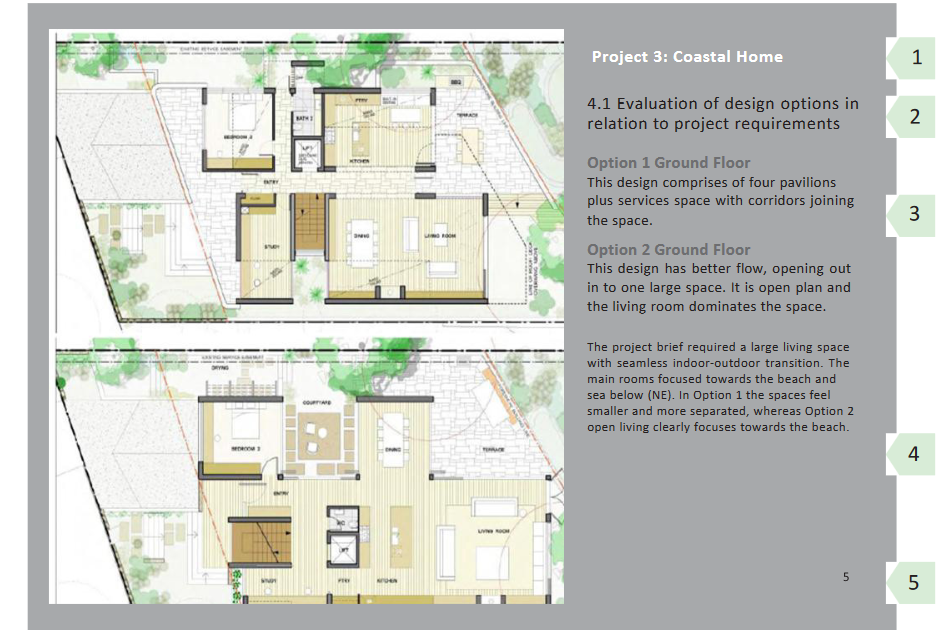
Two projects (including the final-year project, if possible) should be presented with detailed drawings to showcase the conceptual and schematic development. Choose at least one project on which you have been working on the design development. Please don’t include miniature drawings that can’t
be read.
Two project examples should be provided for the two unit sections (E3 Conceptual Design and E4 Schematic Design) in the NSCA Performance Criteria list (excluding knowledge-based criteria). The performance criteria for the other units require only one example/response.
be read.
Two project examples should be provided for the two unit sections (E3 Conceptual Design and E4 Schematic Design) in the NSCA Performance Criteria list (excluding knowledge-based criteria). The performance criteria for the other units require only one example/response.
Include criteria relevant to Knowledge Acquisition (K) as Miscellaneous examples (not specifically related to your own projects) at the end of your portfolio. Such examples may include extracts from regulations and laws, or drawings from any other, unnamed projects.