The APEGBC has implemented a new application process for training engineers seeking to apply to Canada. APEGBS stands for the Association of Professional Engineers and Geoscientists of BC, and the P.Eng (Canada) Competency Report Writing competency assessment method is intended to defend the esteemed reputation, accountability, and expertise of the P.Eng in Canada designation.
The Engineering competency assessment writing system is formulated to ensure that APEGBC’s requirements maintain and safeguard the public interest, while at the same time maintaining a transparent, reasonable, dependable, and efficient registration process.
How to Write a P.Eng (Professional Engineer) EGBC Report for British Columbia?
It is the ability to perform specific industrial tasks and roles to standards anticipated and accepted by employers and the broader community. APEGBC’s competency assessment describes in vivid detail the general competencies related to work experience that are indispensable for professional engineers to ensure successful practice and safety. Instead of writing a long work experience report in chronological order, the new competency assessment writing system requires engineers to fill out a competency self-assessment in important vital areas:
- Communication
- Technical competence
- Project and monetary management
- Group-effectiveness (teamwork)
- Professional Responsibility
- Social, environmental, and economic sustainability
- Personal CPD – continuing professional development.
APEGBC CBA Report Writing Help By Qualified Professional
An engineer using this assessment method must choose the best example from their professional work history that demonstrates a specific level of engineering exposure to a particular key competency. These examples will also require validation from those with direct knowledge of the work conducted. You can usually go for a supervisor or a colleague in that organization. If you have completed validating all your work examples, the assessment phase will proceed, and evaluators from the association will review all the competency work examples and the evaluators’ comments.
During the assessment of the competency level of a P.Eng (professional engineer) in Canada, it is necessary to be very clear that they have not only done well in the situations they have faced up to now, but also have demonstrated the ability to deal with all the likely situations they may encounter in the future. So, APEGBC Competency Assessment Writing requires applicants to demonstrate their ability to apply their engineering knowledge credibly and safely in many different situations. Also, they need to stay prepared to extend their valuable support, deepen their understanding, and seek expert help. Above all, they should make out their professional limitations and act accordingly.
P.Eng (Professional Engineer) Salary in British Columbia
The average salary for professional engineers (Peng) in Canada is $30.63 per hour and $59,721 per year.
The salary for entry-level candidates starts from $26,325 per year, while experienced professionals can make up to $101,526 per annum. As usual, your pay scale increases with greater skills and experience.
APEGBC Competency Assessment Requirements
The competency assessment system (APEGBC) requires applicant engineers to demonstrate their engineering skills and ability to handle complex and natural situations. They are expected to provide comprehensive examples of their knowledge and skills, which will give APEGBC evaluators a clear picture of the professional engineers in Canada across all fields indispensable to safe and effective engineering practice.
-
Competency category:
The competency assessment system comprises seven competency Categories, as mentioned, which are groupings of skills and competencies. The seven categories should represent the critical areas in which professional engineers in Canada across all engineering disciplines should demonstrate their engineering proficiency to ensure safe engineering practice. Each competency category includes a list of the main competencies required in that discipline. Professional engineers who apply should meet the fixed standards for each separate competency category to meet the entire competency requirements of APEGBC.
-
Key competencies:
This category usually requires a recognized knowledge base or skill set that the applicant engineer should have attained to qualify for professional registration. They are behavioral descriptions of what an applicant engineer should have demonstrated in their professional career to meet the required competency level in each competency category. If an applicant wishes to stay ahead of the competition, he/she should meet each key competency at a minimum of degree one on the CRS (competency rating scale). This does not mean that he/she achieved the required average level in every single category.
-
Competency level
The competency rating scale generally ranges from 0 to 5 and outlines six levels of competence, and the achievement of each group is measured using this scale. Every class has a required overall competency level, set at either the second or third level. The average of an applicant’s key competency scores within each category should meet or surpass the fixed minimum level. Engineers should also achieve at least the first level in each key competency.
-
Indicators
These are specific examples of individual skills, actions, activities, or behaviors that an application engineer can use to exhibit the existence and attainment of a particular competency. APEGBC has provided a list of indicators for each key competency to help engineers understand essential information, including the types of examples required, the knowledge needed, and the skills they must develop before attaining professional registration.
How Our Expert Helps in Preparing P.Eng Competence Assessment for BC, Canada
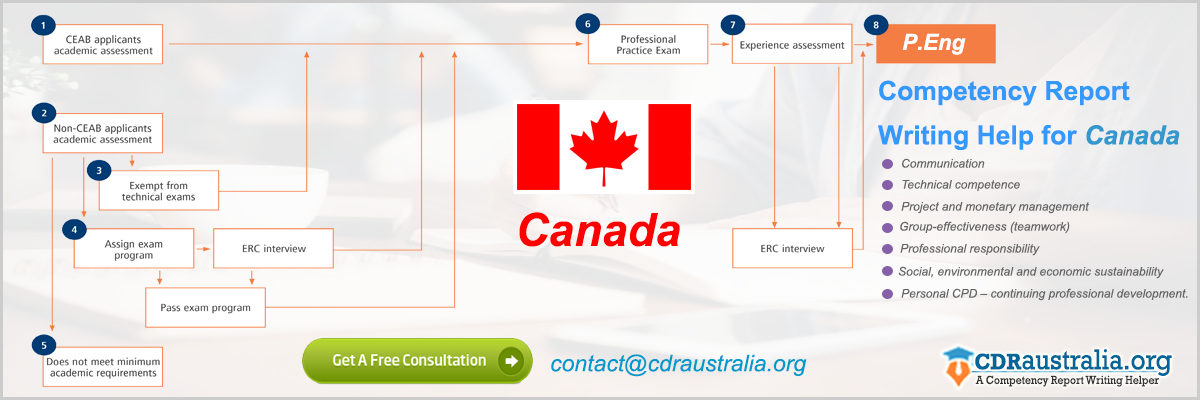
The P.Eng designation is a professional license that allows you to practice engineering in the country or another country where it was granted. Only licensed engineers, or engineers practicing under the direct supervision of a professional engineer, have the legal right to practice engineering in Canada. P.Eng (Canada) Competency Report Writing service help comes in handy there, and we offer you the needed help. We have knowledgeable professionals ready to handle all your writing needs. We at CDR Australia understand your entire case and describe the best examples of your recent engineering activities under each key competency in the finest way, and help demonstrate your accomplishment of the skill. The engineering examples chosen by our expert writers will reflect projects and activities wherein you have had the entire responsibility, which is entirely related to the engineering discipline you mentioned in your application. We are keen on every single detail you provide and are specific in depicting how you have met each key competency.
When choosing examples, we pay close attention to the indicators, as they will help you identify typical evidence to present. We provide you with a customized P.Eng (Canada) competency assessment report by getting your views, ideas, and messages. By hiring experts from CDRAustralia.Org consultants, not only will you get the most excellent report, but you will also have a team of friends who connect deeply.
Our Engineering Competency Report (ECR) assessment writing services will be prepared in accordance with the APEGBC (Association of Professional Engineers and Geoscientists of BC) guidelines. Our writers have many years of experience and conduct extensive research before starting a competency assessment report. The end product will be 100% original. We generally follow the instructions and requirements outlined in the booklet guidelines when writing the report. We don’t simply write your story but sculpt it!