Computer engineers seeking skilled migration to Australia must demonstrate their qualifications and competencies through a Competency Demonstration Report (CDR) assessed by Engineers Australia (EA). Computer engineers can get skills assessment as an Engineering Technologist (ANZSCO 233914) role from EA if the assessed role aligns with applied and technology-focused engineering practice.

Below CDR writing guideline provides a structured, research-based walk through of the entire CDR preparation process for computer engineers, strictly aligned with Engineers Australia’s Migration Skills Assessment (MSA) framework and commonly recommended best-practice sources as engineering technologist ANZSCO 233914.
Understanding the CDR and Your Eligibility
The Competency Demonstration Report (CDR) for computer engineer is a migration-oriented portfolio that proves an engineer’s ability to meet Australian Stage 1 competency standards for the nominated engineering occupation. Engineers Australia accepts CDRs from applicants with non-accredited engineering qualifications, or those whose occupation title differs from their accredited qualification, under the CDR assessment pathway.
For computer engineers, the relevant pathways are typically Engineering Technologist (ANZSCO 233914), if the background is more applied, implementation-oriented, and technology-focused.
Engineers Australia explicitly confirms that Engineering Technologist (ANZSCO 233914) is assessed against Stage 1 Competency Standards for an Engineering Technologist, and the CDR pathway is a standard route for non-accredited or mismatched qualifications. ANZSCO 233914 Engineering Technologists are expected to analyse, adapt, and apply existing engineering technologies to real-world projects, conduct performance tests, assist in design and development, and comply with safety and quality standards.
Confirming Your ANZSCO and Occupational Category
Before drafting the CDR for computer science and engineering, the applicant must decide the ANZSCO occupation code and occupational category (Professional Engineer, Engineering Technologist, Engineering Associate, or Engineering Manager). For computer-related roles ANZSCO 233914 – Engineering Technologist (often suitable for computer engineers with strong implementation, testing, and systems-integration experience).
Engineers Australia (EA) notes that the occupation category and ANZSCO code must match the evidence in the CDR; selecting an incorrect occupation usually leads to rejection or reassessment. If the applicant is unsure, the EA website provides a qualification checker and a quiz tool to help distinguish between pathways and occupational categories.
Core Components of the CDR for Computer Engineers
Engineers Australia requires a standard CDR (Competency Demonstration Report) structure for all engineering disciplines, including computer engineering. The components are consistent across occupational categories, although the mapped competencies will differ. For a computer engineer, the CDR must contain:
1. Continuing Professional Development (CPD)
The CPD is a concise list of training, workshops, certifications, and self-directed learning activities undertaken after graduation. For computer engineers, EA-oriented best-practice examples include:
- Technical courses in programming languages, cloud platforms, cybersecurity, embedded systems, or networking.
- Vendor- or platform-specific certifications, where relevant.
- Internal company training, webinars, and research-oriented learning.
Each entry should include date, duration, and brief description; the list should highlight continuous enhancement of technical skills rather than generic soft-skills training.
2. Three Career Episodes (CEs)
Each Career Episode is a first-person narrative of a specific project or role phase, typically 1,000 to 2,500 words, demonstrating application of engineering knowledge to real problems. For computer engineers, suitable projects include:
- Software development or system-design projects (e.g., network-based applications, embedded systems, real-time systems, or distributed applications).
- Systems integration, testing, or optimisation of computer networks, databases, or cloud infrastructures.
- Hardware-software co-design, firmware development, or performance tuning of complex systems.
Each Career Episode should follow a clear structure:
- Introduction: Project title, dates, location, and organisational context.
- Background: Technical landscape and the project’s scope.
- Personal role: Detailed responsibilities; avoid generic statements such as “team member” and instead specify design, coding, testing, debugging, documentation, or integration tasks.
- Technical details: Tools, platforms, algorithms, and methodologies used.
- Problem-solving and outcomes: How the applicant resolved specific technical issues, validated the solution, and contributed to project success.
Engineers Australia requires that each episode highlights different aspects of the Stage 1 competency elements (e.g., knowledge base, problem analysis, design, testing, communication, ethics).
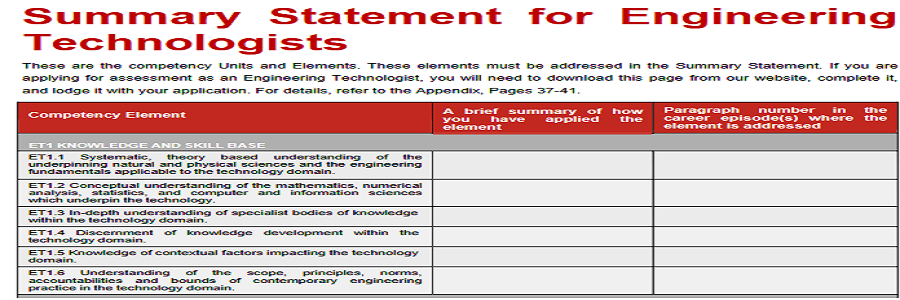
3. CDR Summary Statement
The CDR Summary Statement is a tabular matrix that cross-references sentences from the Career Episodes against the 16 competency elements defined in Engineers Australia’s MSA booklet for the relevant occupational category. For computer engineers, the assessor expects:
- Clear mapping of technical activities (e.g., algorithm design, system architecture, testing, debugging) to elements such as PE1 – Knowledge and skill base, PE2 – Engineering application abilities, PE3 – Professional and personal attributes, and PE4 – Communication and teamwork.
Each competency element must be supported by at least one well-chosen sentence from a Career Episode, with the exact paragraph number and page number indicated.
Choosing the Right Pathway: CDR vs Accredited Qualifications
Engineers Australia distinguishes between accredited qualification pathways (Washington, Sydney, Dublin, and Australian pathways) and the Competency Demonstration Report (CDR) pathway. Computer engineers should choose the CDR pathway route if:
- Their qualification is not accredited under any Accord.
- Their degree title does not match the intended occupation (e.g., a computer engineering degree nominated for Engineering Technologist).
- They hold a provisionally accredited Australian qualification.
Applicants must use the IEA qualification checker to confirm whether their degree is accredited and in which category (Professional Engineer, Engineering Technologist, or Engineering Associate). If the degree is not accredited, the CDR pathway is mandatory for a migration skills assessment.
Writing the CDR: Technical and Language Standards
Engineers Australia emphasises originality, technical depth, and clarity in CDRs and explicitly warns against plagiarism and AI-generated content. Best-practice sources note that EA assessors use Turnitin and Plagscan to detect copying, and Grammarly-type checks for grammar and style. For a computer engineer, the following drafting guidelines are recommended:
- Use first-person singular (“I designed”, “I implemented”, “I tested”) and avoid generic third-person descriptions.
- Maintain consistent technical terminology (e.g., “real-time operating system”, “distributed web service”, “network protocol stack”) aligned with the nominated ANZSCO 233914 (Engineering Technologist) role.
- Avoid over-theoretical explanations; instead, link theory explicitly to design choices, testing, and validation.
- Keep sentences concise and logically ordered, with emphasis on problem–solution–outcome in each project.
Reports must be plagiarism-free; any detected copying can lead to rejection and a ban on reapplication for 12–36 months.
CDR for Computer Engineer as Engineering Technologist (ANZSCO 233914)
Computer Science engineers whose roles are more applied and implementation-oriented than high-level design may seek assessment as an Engineering Technologist (ANZSCO 233914). The Engineering Technologist role:
- Focuses on analysing and adapting existing engineering technologies for real-world projects.
- Involves testing, troubleshooting, optimising, and maintaining systems, rather than purely theoretical or research-based work.
For a computer engineer targeting ANZSCO 233914, the CDR should emphasise:
- Application of standardised computing or networking technologies (e.g., implementing network-based systems, deploying cloud-based services, configuring embedded platforms).
- Testing and validation activities: load testing, performance tuning, reliability checks, or compliance with safety and quality standards.
- Collaboration with engineers and cross-functional teams to implement solutions, document results, and ensure operational robustness.
The Summary Statement should explicitly map evidence to Engineering Technologist Stage 2 competency standards, highlighting practical application, problem-solving, communication, and ethical conduct.
Document Preparation, Submission, and Processing
Once the CDR is drafted, the applicant must gather all supporting documents and submit them via the Engineers Australia online portal. Typical inclusions for the CDR-based application are:
- Certified copies of academic transcripts and degree certificates.
- Evidence of English language proficiency (e.g., IELTS, PTE, TOEFL) meeting EA’s minimum thresholds.
- Employment-related documents (offer letters, experience certificates, or project reports) where applicable.
Standard processing for migration-skills-assessment applications is around 15 weeks for assignment to an assessor, with total processing time influenced by the quality of the CDR and whether additional information is requested. Fast-track options (for an additional fee) can reduce processing to about 20 working days, but the technical rigour of the CDR remains decisive.
Possible outcomes include:
- Positive skills assessment, enabling the applicant to proceed with an Expression of Interest (EOI) for visa classes such as 189 or 190.
- Feedback or request for further information, if some competencies are not adequately demonstrated.
- Rejection, due to weak competency mapping, plagiarism, or structural non-compliance.
Final Recommendations for Computer Engineers
For a computer engineer preparing a CDR for Engineers Australia as Engineering Technologist, the critical success factors are:
- Correct occupational category and ANZSCO code selection, aligned with the degree and work history.
- Three technically detailed, non-repetitive Career Episodes, each demonstrating a different facet of engineering practice (design, implementation, testing, maintenance, or integration).
- A tight, accurate Summary Statement that maps explicit examples from the episodes to the relevant competency elements.
- A plagiarism-free and original report, written in clear, professional English, with no generic or AI-generated phrasing.
If the applicant’s profile is more hands-on and implementation-driven, Engineering Technologist (ANZSCO 233914) is a viable and often appropriate route, provided the CDR clearly reflects applied engineering practice rather than purely theoretical or research-oriented work. Following these step-by-step guidelines and EA-oriented best practices will maximise the probability of a successful skills assessment outcome.
Frequently Asked Questions (FAQs)
The ANZSCO Code for computer engineering is 233914 to get skills assessment as engineering technologist.
Computer Engineer can apply as Engineering Technologist to get skills assessment from Engineers Australia (EA) to recognise their qualification in Australia to for Visa processing.
Yes, Engineers Australia is assessing body for computer scinece and engineering candiates as Engineering Technologists in Australia.
Drafting the computer engineeering CDR as engineering technologists requires three projects and It may be college final year project, internship projects, mini project or work experience related projects.
Yes, CDRAustralia.Org provides CDR report writing support to computer engineers who are looking to get skills assessment as engineering technologists from Engineers Australia.