Navigating the Australian migration process as a Penetration Tester requires a clear understanding of how the Australian Computer Society (ACS) evaluates technical skills. If you do not hold a formal ICT degree, or if your qualification is not closely related to your current role, the Recognition of Prior Learning (RPL) assessment pathway is the primary route for ANZSCO 261317 Penetration Tester to a successful MSA ACS skills assessment.
This process allows you to demonstrate that your years of professional experience have provided you with a level of knowledge equivalent to a formal tertiary education.
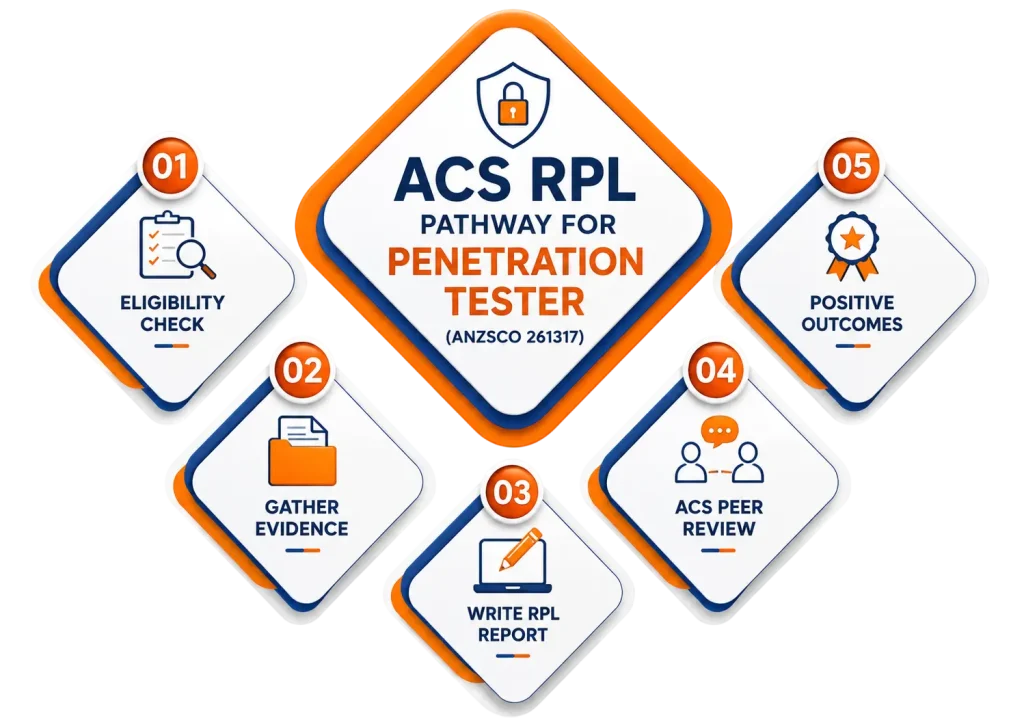
ACS RPL Pathway for Penetration Tester (ANZSCO 261317) for Australian PR
The ACS RPL pathway is specifically designed for professionals who have acquired their ICT expertise through years of on-the-job experience rather than a university classroom. To get Australian Permanent Residency (PR), you must first receive a “Suitable” skills assessment from the ACS Australia.
If you have a non-ICT degree, you generally need six years of relevant work experience. If you have no tertiary qualifications, you will typically need 8 years of experience. Once the ACS validates your skills, you can claim points for your age, English proficiency, and work experience under the General Skilled Migration (GSM) program. This allows you to apply for visas such as the Skilled Independent visa (Subclass 189), the Skilled Nominated visa (Subclass 190), or the Skilled Work Regional visa (Subclass 491).
How to Draft ACS RPL Report for ANZSCO 261317 Penetration Tester?
The ACS RPL report is the core of your application. You are essentially writing a technical thesis that proves you possess the “Body of Knowledge” expected of an ICT professional. The 2024 ACS RPL form requires you to complete two main sections: The Key Areas of Knowledge and the Project Reports.
For the Key Areas of Knowledge, you must explain how your experience relates to the various areas of the ACS Core Body of Knowledge. You should focus on topics like ICT Security, Network Protocols, and Systems Development. Instead of listing tools like Burp Suite or Metasploit, explain the underlying logic of how you use them to secure an infrastructure.
The Project Reports section requires you to detail two significant projects you have completed in the last few years. For a Penetration Tester, a project could be a comprehensive red-team engagement for a corporate client or a deep-dive web application security assessment for a new software launch.
When Writing ACS RPL Report, follow a structured approach:
- Project Context: Define the scope, the security objectives, and your specific role.
- The Technical Challenge: Explain the complexities of the system you were testing. Was it a legacy environment? Did it involve complex cloud configurations?
- Your Solution: Detail the methodologies you chose. Explain why you opted for a specific testing framework over another.
- The Outcome: Describe the vulnerabilities found, the risk they posed, and the remediation steps you advised.
How to Prepare Professional Currency Evidence?
The ACS now places significant emphasis on “Professional Currency.” This means you must prove that you are staying up to date with the rapidly changing cybersecurity landscape. You cannot rely solely on work you did five years ago; you must show active engagement with the industry today.
To write your Professional Currency Evidence, you should focus on three main pillars:
Continuing Professional Development (CPD)
List any recent certifications, such as CISSP, CISM, or advanced offensive security certifications. Include the hours spent on these courses.
Industry Engagement
Mention your involvement in security conferences (like BSides or CrikeyCon), participation in bug bounty programs, or any published research and whitepapers.
Recent Work Contributions
Briefly describe how you have applied new technologies or methodologies in your most recent professional role.
You should aim to demonstrate at least 20 hours of professional development per year. This evidence shows the assessor that your skills are sharp and that you are ready to contribute to the Australian tech ecosystem immediately.
Essential Components of the ACS RPL Form
When you open the 2024 RPL form, you will notice it is divided into clear sections that demand specific technical details. You must be precise with dates and ensure that the projects you choose are significant enough to demonstrate a broad range of skills.
In the “Key Areas of Knowledge” section, do not simply copy and paste definitions from textbooks. The ACS wants to see your personal interpretation and application of these concepts. For example, when discussing “ICT Management,” describe how you manage the lifecycle of a vulnerability from discovery to patching within a corporate hierarchy.
For the “Project Report” section, ensure you are using the correct terminology. Use headers to break up the text and provide a clear narrative of the project’s progression. You must prove that you were the one making the technical decisions. Avoid using “we” and focus on “I”—as in “I designed the exploit script” or “I interpreted the packet captures to identify the data exfiltration point.”
Employment Duties in the ACS Framework
The ACS classifies cybersecurity roles under specific ANZSCO codes to ensure applicants meet the national standards for the Australian workforce. For a Penetration Tester, your assessment focuses on your ability to identify, exploit, and remediate security vulnerabilities within complex systems.
When you prepare your application, you must align your past work experience with the official ACS descriptions. This is not just a list of jobs you have held; it is a technical map of your competencies. You are expected to show proficiency in the following employment duties:
Methodology Development: You develop and execute comprehensive penetration testing methodologies and strategies designed to identify weaknesses in security controls across various environments.
Threat Emulation: You plan, coordinate, and conduct cyber threat emulation activities. These are used to verify deficiencies in technical security controls and provide the basis for remediation recommendations.
Risk Analysis and Test Cases: You create detailed test cases by performing in-depth technical analysis of risks and typical vulnerabilities inherent in modern software.
Attack Vector Identification: You identify specific vulnerability exploitations and potential attack vectors into a system, followed by an analysis of vulnerability scan results to assess broader security loopholes.
Material Production: Your role involves producing test scripts, materials, and packs specifically designed to probe new and existing software or services for security flaws.
Social Engineering and Awareness: Where applicable, you conduct phishing attacks or other simulated social engineering tests to evaluate how effective an organisation’s security awareness training truly is.
How Much Money Do Penetration Testers Earn in Australia?
The demand for cyber security professionals in Australia remains high, driven by increased regulatory scrutiny and a rise in high-profile data breaches. As a result, the financial rewards for skilled Penetration Testers are significant.
|
Experience Level |
Average Annual Salary (AUD) |
|
Junior / Entry Level |
$85,000 – $105,000 |
|
Mid-Career |
$110,000 – $145,000 |
|
Senior / Lead Tester |
$150,000 – $190,000+ |
Technical Documentation and Verification
Every claim you make in your RPL report must be backed by evidence. This includes your employment reference letters, which must be on official company letterhead and signed by a supervisor or HR manager. These letters must explicitly list your duties, and these duties should closely mirror the Penetration Tester ANZSCO requirements mentioned earlier.
If you are self-employed, you will need to provide third-party evidence, such as client contracts, invoices, and perhaps a statutory declaration. The goal is to create a seamless link between your RPL report narratives and your formal employment records.
Focus on the technical depth of your work. The ACS assessors are ICT professionals themselves; they are looking for evidence of high-level analytical thinking and problem-solving. By detailing the “how” and “why” of your penetration testing career, you provide the necessary proof that you meet the Australian standard for skilled migration.
