All chemical engineers strive for becoming a chartered Chemical engineer with the IChemE. Attaining this designation is going to mark a significant milestone for engineers. It showcases the demanding peer evaluation as well as the industry recognition of your professional competence and commitment.
That is why it is highly important to understand the process of achieving the status of a Chartered Chemical Engineer with the Institute of Chemical Engineers (IChemE). This pathway necessitates candidates to demonstrate their practical experience along with technical understanding and ethical application while following the engineering principles.
You need to meet three things for becoming a Chartered Chemical Engineer with IChemE:
👉 The required academic base
👉 The right professional development
👉 The professional review standard
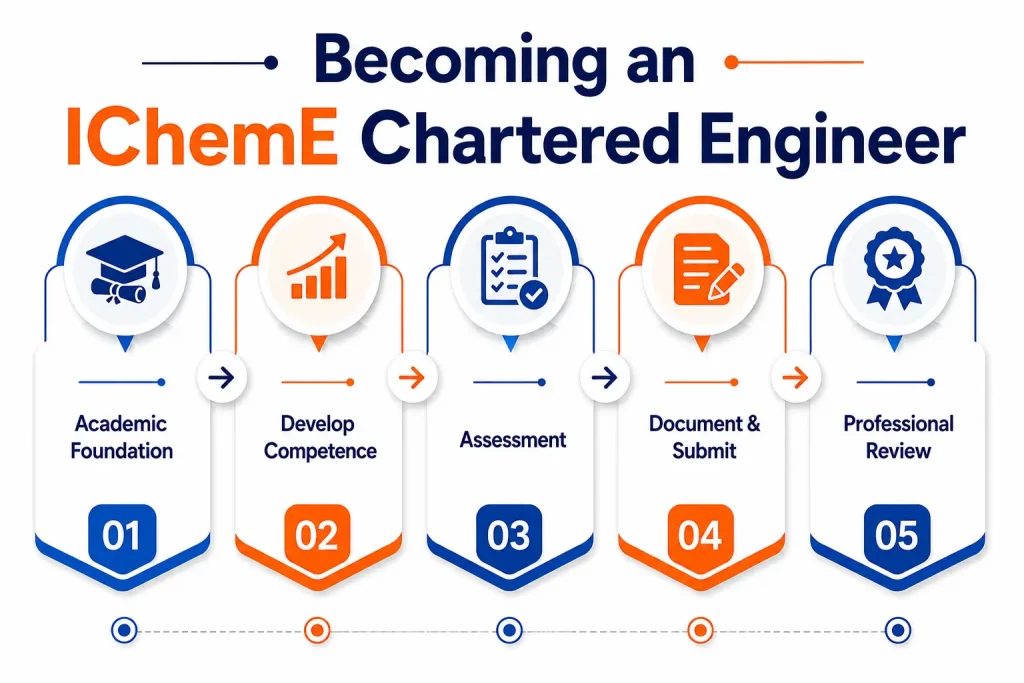
IChemE describes Chartered Membership as recognition of your professional competence and commitment, and successful applicants can use the title Chartered Chemical Engineer and the post-nominal MIChemE.It also states that Chartered Membership is peer reviewed and externally validated, which is why the application process is more than a formality. You are expected to show that you can apply chemical engineering knowledge responsibly, communicate clearly, and work with professional integrity.
CDRAustralia.Org provides professional expert guidance and support for engineers who want to become a chartered engineer with IChemE (The Institution of Chemical Engineers). IChemE is a not-for-profit, member-led learned society and qualifying body that advances chemical engineering’s contribution worldwide. Our qualified writers are highly experienced and support the preparation of reports with plagiarism-free work and free from AI tools.
What IChemE Means by Chartered Status
The Institute of Chemical Engineers defines a Chartered Engineer as a competent practitioner committed to the highest professional standards. The candidate’s application must prove their technical knowledge, show judgement, responsibility and ethical conduct in real work settings.
This title will be recognised by the employers, peers, regulators and society. IChemE also notes that chartered members are eligible for using the title – Professional Process Safety Engineer or Chartered Chemical Engineer, depending on the route. The institute further links the membership with significant professional benefits. This includes career development, peer recognition, salary progression and access to post-nominals.
Steps to Become a Chemical Chartered Engineer with IChemE
We have outlined a complete step-by-step procedure required to achieve Chartered Member (MIChemE) status through the Institution of Chemical Engineers (IChemE).
Step 1: Check Your Academic Base
Your first check is academic eligibility. IChemE explains that qualifications accredited at M-Standard meet the full academic requirements for Chartered Member and Chartered Engineer, so no extra evidence is needed for the knowledge and understanding stage.
If your qualification is B-Standard or non-accredited, IChemE says you may need further evidence through a Technical Biography or an Individual Case Procedure assessment. In practical terms, you need to show that your education and learning still meet the academic standard expected for chartership.
Step 2: Build Professional Experience
After your academic base, you need professional experience that demonstrates Initial Professional Development, often referred to as IPD. IChemE’s guidance indicates that applicants usually need several years of work experience, and the experience must show how your skills, responsibility, and technical judgement have developed in practice.
This stage is not about simply listing job duties. IChemE expects evidence that you have handled real engineering work, taken responsibility for technical decisions, and developed professional behaviour through applied experience.
What your experience should show
Your experience should show breadth and depth across chemical engineering practice. IChemE’s presentation materials point to areas such as process plant operation, design, project management, quality, risk, sustainability, technical evaluation, and health and safety.
You should be able to show that you have done more than observe work. IChemE notes that professional responsibility can include working under your own supervision, training others, managing budgets, and being responsible for the consequences of your technical decisions.
Step 3: Prepare the Competence and Commitment report (C&C)
The Competence and Commitment report, often called the C&C report, is central to the application. IChemE says it is evidence of professional competence, should be no more than 3,000 words, and should use plain English with practical examples from your own work.
The report needs to address the key areas IChemE assesses, including technical knowledge, problem solving, responsibility, communication, ethical conduct, and continuing professional development. The strongest reports are specific, work-based, and focused on what you personally did, not what the wider team did.
What IChemE wants to see in the C&C report?
- One strong example of problem solving or technical judgement.
- Evidence of responsibility in real work situations.
- Clear examples of communication with colleagues, stakeholders, or clients.
- Evidence of safe, ethical, and professional conduct.
- A record of continuing professional development and future goals.
The institute recommends its applicants to ensure that the examples are relevant, technical and free from confidential information.
Step 4: Arrange verification and referees
Your C&C report needs third-party verification. IChemE says verifiers must be familiar with your work and hold a position of responsibility, but they do not necessarily need to be Chartered Members or chemical engineers.
You also need two referees who are Chartered or Fellow Members of IChemE and know your work and career. IChemE’s guidance says these referees can be a superior, mentor, regional group member, or university lecturer, provided they are suitable and familiar with your professional background.
Step 5: Submit your application online
IChemE says you must register or log in through the application system before applying for Chartered Membership. Once you have an account, you can submit your personal details, employment details, qualification details, stage-specific documents, and payment information through the portal.
Your checklist normally includes your C&C report, academic qualifications, technical or design evidence if relevant, photo ID, and a tailored CV. IChemE also says the CV should be up to date, concise, and focused on relevant experience only.
Step 6: Prepare for the review interview
After your submission is reviewed, you attend a peer review interview. IChemE describes this as an interview of about one hour, usually with trained Chartered Members or Fellows, and the questions are based on your C&C report and CV.
This interview is there to test whether your written evidence matches your actual experience. You should be ready to explain your decisions, your technical judgement, your responsibility level, and the way you have applied chemical engineering knowledge in practice.
Educational Prerequisites
The foundation for Chartered status rests on your academic qualifications. These determine your entry point and whether further learning is required.
IChemE accredits degree programmes against specific standards:
- M-Standard: These integrated degrees (often MEng) meet the full academic requirements for Chartered Member (MIChemE) and Chartered Engineer (CEng). They provide a solid foundation (first cycle) and advanced chemical engineering knowledge (second cycle).
- B-Standard: These first-cycle degrees (often BEng or BSc) meet the academic requirement for Incorporated Engineer (IEng).
- F-Standard: These second-cycle degrees (often MSc) meet the Engineering Council’s Further Learning requirements.
If you hold an accredited B-Standard degree, you can supplement it with an accredited F-Standard qualification to meet the full requirements for Chartered status. If your degree is not accredited, IChemE will conduct a rigorous individual assessment of your knowledge and understanding.
This academic foundation prepares you for the practical application of your skills in industry.
Professional Experience and Training
Following graduation, the focus shifts to developing professional competence through structured training and documented experience. You must be an Associate Member to begin this phase.
There are two primary routes to validate your training:
- Accredited Company Training Scheme (ACTS): This is a structured, IChemE-approved scheme provided by your employer. It offers a clear framework for professional development.
- Initial Professional Development (IPD): If your employer does not offer an ACTS, you can undertake self-managed IPD. This route requires you to record and verify your training and work experience independently, demonstrating how you meet the required competencies.
Both pathways culminate in the final assessment stage, where your documented experience is evaluated.
How to Prepare the C&C Report for IChemE Chartered Credential?
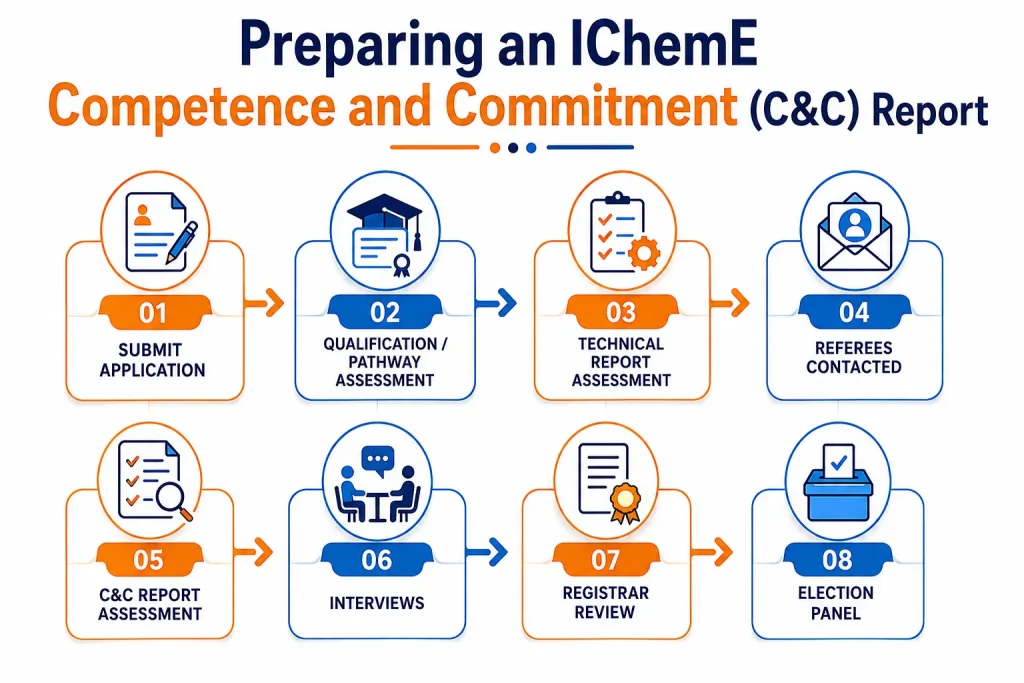
IChemE’s Competence & Commitment report is the key document in the professional review process. It must demonstrate your competence, commitment, and ability to apply chemical engineering principles in real work situations.
To prepare it effectively, start by mapping your experience against the report sections in IChemE’s template: position of responsibility, Section A to E, verification, and referees. Use one strong example where possible, avoid vague descriptions, and focus on your individual contribution rather than the team’s overall work.
A strong C&C report should:
Include only relevant, non-confidential technical detail.
Use first person singular, such as “I designed” or “I analysed”.
Show chemical engineering judgment, not just project management.
Stay concise and within the word limit.
Use clear, correct English and avoid unnecessary acronyms. IChemE also expects the report to be verifiable and consistent with your CV and interview answers.
Tips to Avoid C&C Report Rejection
Most rejections or revision requests happen when the report is too generic, too long, or does not clearly demonstrate chemical engineering competence. IChemE says reviewers may ask for clarification or expansion if sections are weak, and the applicant will usually have one chance to revise them.
To reduce the risk of rejection:
- Use specific, work-based examples rather than general statements.
- Show what you did, not what the team did.
- Keep the report within the required word count.
- Make sure each subsection is balanced in length.
- Make sure to avoid adding any kind of confidential details, inflated claims or passive phrasing.
- Prepare early so that the verifiers and referees are ready when needed.
IChemE also recommends its applicants to review the guidance carefully and make sure the report can stand up to interview discussion.

