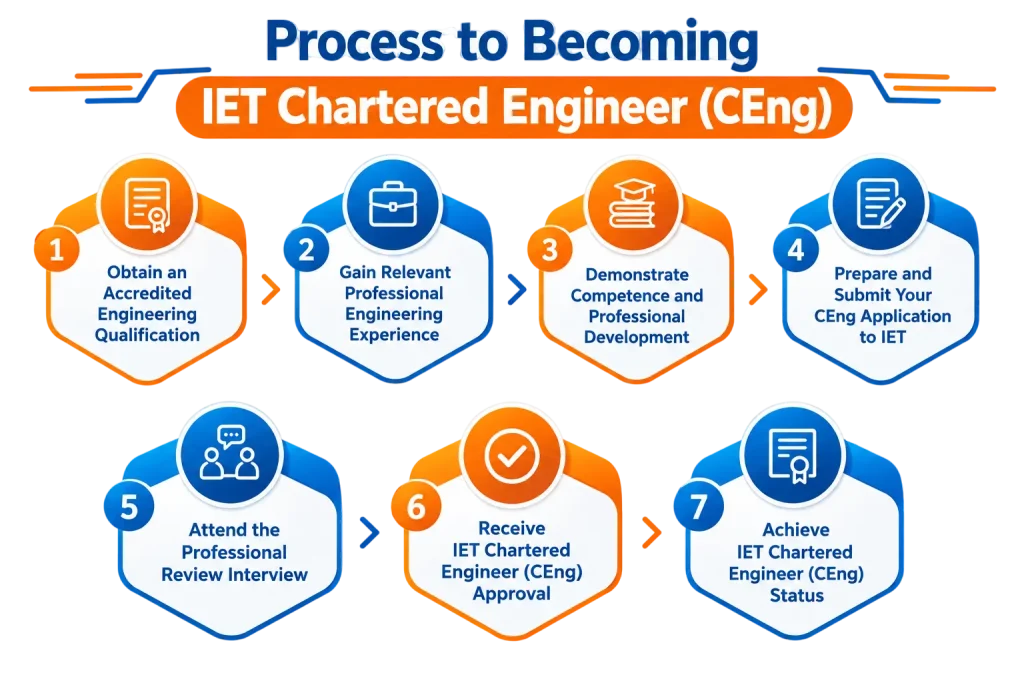
Candidates looking forward to becoming a Chartered Engineer (CEng) through the Institution of Engineering and Technology (IET) involves a structured series. These steps form a crucial part in validating your professional competence against various international benchmarks. The qualification is officially awarded by the Engineering Council UK, wherein IET manages the assessment and professional review for the concerned candidate.
It is highly important for the candidate to demonstrate specific professional abilities. Understanding the exact pathways can help to plan the submission effectively without any mistakes. CDRAustralia.Org offers expert guidance to become chartered Engineer with IET (UK) to maximize the chance of approval with competency preparation required for chartership credentials.

What is IET Chartered Engineer Status (CEng) in the UK?
Chartered Engineers are responsible for developing solutions to complex engineering challenges, leading teams, introducing new technologies and overseeing high-level decisions. CEng status shows you meet the UK Standard for Professional Engineering Competence (UK-SPEC) and maintain these standards throughout your career.
The registration carries lasting professional value. You gain recognised credibility with employers and clients, stronger prospects for leadership or specialist roles, and global mobility across engineering markets.
How Does IET CEng Registration Benefit?
When candidates become a Chartered Engineer, this title comes with lasting and positive impact on their career. The primary benefits include-
- Earn professional recognition through CEng status and meet a reputed global benchmark for engineering excellence.
- Registered engineers are often fast-tracked into leadership, consultancy and specialist roles.
- CEng demonstrates your capability, judgment and professionalism in complex settings.
- CEng is widely recognized, enabling work and collaboration across the world.
- Professional Registration demonstrates that you operate to the highest ethical, safety and quality standards.
Overview of the Eligibility Pathways to CEng IET
You can meet the Chartered Engineer standard and earn the CEng title through different academic and experiential pathways. The focus is on demonstrating required professional competencies rather than following one fixed qualification route. There are two main paths by which the IET assesses its applicants-
1.) Recognised Qualifications Route
This is the most straightforward path if you hold:
- An accredited Master’s degree in engineering
- An accredited Bachelor’s degree with honours plus further learning to Master’s level
- An integrated Master’s degree (MEng)
2.) Individual Assessment Route
If your degrees are unaccredited or you lack a Master’s-level qualification, you can still apply. Assessors evaluate your work-based learning to ensure your knowledge matches the required baseline.
Experience Benchmark
Most applicants typically have four to six years of post-graduate experience operating at a professional, decision-making level, though there is no strict year requirement.
IET CPEng Competence and Commitment Standards
Your application centres on proving you meet the 17 sub-competencies and commitment standards across five main areas set out by the UK Standard for Professional Engineering Competence or UK-SPEC. These cover five core areas that define what a Chartered Engineer should demonstrate.

| Competency Area | Core Focus | What You Need to Prove |
| A: Knowledge & Understanding | Technical foundations | Using engineering principles to exploit emerging technologies or introduce new methods |
| B: Design & Development | Application & problem solving | Implementing engineering solutions, managing design processes and overcoming technical challenges |
| C: Leadership & Management | Responsibility & commerce | Handling budgets, managing teams and taking technical responsibility for complex projects |
| D: Communication Skills | Interpersonal skills | Clear professional communication, presenting technical arguments and negotiating |
| E: Professional Commitment | Ethics & standards | Dedication to safety, sustainability, codes of conduct and Continuing Professional Development (CPD) |
Competence combines knowledge, understanding and skills developed through formal and informal learning, training and experience. Commitment means demonstrating dedication to the profession, society and environment through ethical conduct, safety practices, sustainability and active participation.
Step-by-Step Application Preparation Process to get CEng Status with IET
The entire process is managed through the IET’s online portal. The steps involved are as follows:
1. Check Your Eligibility
If you’re unsure which route is right for you, use the eligibility guidance or talk to a Professional Registration Advisor (PRA).
2. Join the IET and Set Up Career Manager
You must be a current member of the IET before applying. Sign up to Career Manager to record your CPD and see how your projects relate to UK-SPEC areas.
3. Work with a PRA
IET gives you access to a voluntary PRA who will review your draft application free of charge to see if you have provided sufficient evidence before you pay any fees.
4. Identify Your Supporters
You must have at least one supporter (preferably a registered CEng or your line manager) who can verify your work history and confirm your professional conduct.
5. Prepare and Submit Your Portfolio
Fill in the application form (max 12 pages) and enclose certified copies of your higher education certificates, transcripts, organization accountability diagram and development action plan. You will pay the non-refundable application fee here.
Assessment and the Professional Review Interview
When you apply, your application is checked to ensure it is complete. This is a pre-interview assessment by trained IET members and you may be asked for additional evidence if required.
If your evidence is up to standard, you will be invited to the Professional Review Interview (PRI) The interview is approximately 1 hour long and involves a 15 minute presentation of your engineering achievement, followed by a detailed interview with two trained IET interviewers who will question you on your professional judgment and competency markers.
Final Approval and Registration
Your interviewers forward a report with your application to a final assessment registration panel that makes the final decision. If successful you will be entered onto the Engineering Council Register as a Chartered Engineer.
You pay the Engineering Council Entrance Fee to finalise registration. Once paid, your details are submitted to the Engineering Council, and registration usually goes live within six weeks. You can then display the CEng post-nominal.