Becoming a Chartered Project Professional (ChPP) requires demonstrating advanced technical knowledge, proven professional practice across complex projects, and strict adherence to ethical behaviour as assessed by the Association for Project Management (APM).
Project professionals achieve this globally recognised credential by selecting one of four official assessment pathways, submitting written evidence mapped against the APM Competence Framework, verifying 35 hours of annual Continuing Professional Development (CPD), and passing a structured peer-review interview.
You do not need to hold a formal project management qualification or active APM membership to apply, nor does the APM enforce a minimum number of years in the field. Instead, assessors evaluate the actual complexity of the projects, programmes, or portfolios you have delivered and your personal decision-making authority within those environments.
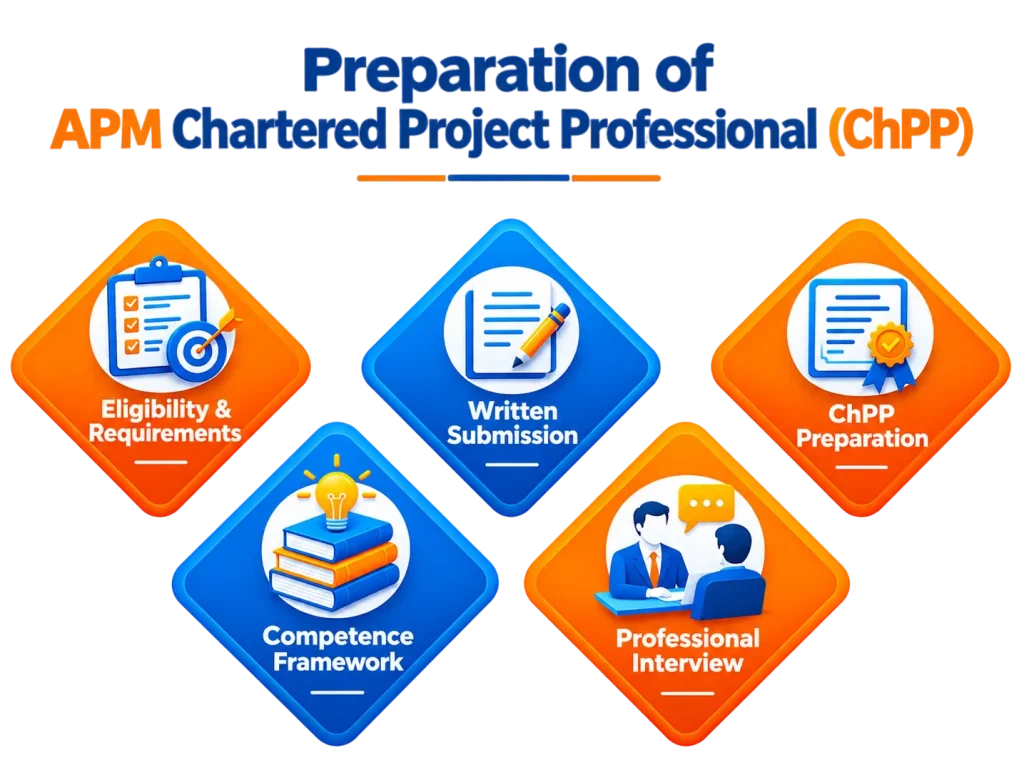
CDRAustralia.Org is a trusted provider of expert guidance for engineers preparing APM ChPP competencies. We ensure all submissions are 100% plagiarism-free and comply with APM requirements, without using AI tools.
What is the Chartered Project Professional (ChPP) Standard and Who Qualifies?
The Chartered Project Professional designation serves as the benchmark credential for senior practitioners managing major capital works, technology rollouts, defence contracts, and organisational transformation programmes. Before you begin compiling project evidence, you need to verify how the APM defines readiness and whether your day-to-day responsibilities align with the chartered standard.
Core Eligibility Criteria for Applicants
Project managers, programme directors, and portfolio leads from both public and private sectors apply for ChPP status to validate their practical capability against an independent international standard. Assessors look past job titles and focus on what candidates actually do when managing delivery pressures, stakeholder conflicts, and governance controls. To qualify for assessment, applicants must satisfy five baseline requirements:
👉 Active Professional Practice:
You must be professionally active with a verifiable track record of delivering complex projects, programmes, or portfolios, or operating in a primary enabling and control function (such as leading a Project Management Office or enterprise risk function).
👉Breadth of Project Experience:
Candidates need enough practical exposure across the project lifecycle to satisfy the required mandatory and elective competences drawn from the APM Competence Framework.
👉Advanced Technical Knowledge:
Applicants must be able to evaluate, critique, and analyse the theoretical principles behind current project management methods rather than just following company templates.
👉Continuing Professional Development (CPD):
Every candidate must log at least 35 hours of relevant professional learning completed within the 12 months prior to submitting their application.
👉Ethical Conduct and Endorsement:
You must commit to the APM Code of Professional Conduct and nominate two professional proposers who can verify your identity, career history, and suitability for chartered status.
Why Formal Qualifications are Optional
Many experienced practitioners assume they need an academic degree or a stack of exam certificates before applying for chartership. The APM designed the ChPP standard so that seasoned practitioners without formal qualifications have the exact same opportunity to achieve chartered status as those holding accredited diplomas.
If you have spent years running multimillion-dollar infrastructure upgrades or complex software integrations, your practical delivery record carries full weight through the experiential pathway.
The Four Official APM Pathways to Chartered Status
The APM updated its assessment structure into four distinct pathways to reflect the different career backgrounds of modern project specialists. Every applicant is tested against the same bar for technical knowledge and professional practice, yet the testing format changes based on whether you already hold an APM-recognised assessment.
Breaking Down Pathways 1, 2, 3, and 4
Choosing the wrong pathway delays applications and leads to avoidable resubmission fees. If you hold a prior certification, such as the APM Project Professional Qualification (PPQ), Registered Project Professional (RPP), or an accredited corporate assessment scheme, you can bypass parts of the written or oral testing.
Practitioners who rely purely on their work history enter through Pathway 1, which tests a smaller sample of written competences upfront and uses an extended two-hour interview to probe both theoretical depth and real-world application.
Comparison of ChPP Assessment Pathways
The table below outlines how the four official APM pathways differ in eligibility, written portfolio scope, and interview duration.
| APM Pathway | Target Applicant Profile | Written Submission Requirement | Interview Format and Duration |
| Pathway 1 | Candidates who meet eligibility criteria without holding any prior recognised assessment | Project overviews plus professional practice statements covering 7 competences | 2-hour interview assessing both professional practice and technical knowledge |
| Pathway 2 | Candidates who hold an APM-recognised assessment for technical knowledge | Project overviews plus professional practice statements covering 12 competences | 1-hour 15-minute interview assessing professional practice, ethics, and CPD |
| Pathway 3 | Candidates who hold an APM-recognised assessment for professional practice | Project overviews plus professional practice statements covering 8 competences | 1-hour interview assessing technical knowledge, ethics, and CPD |
| Pathway 4 | Candidates who hold recognised assessments for both technical knowledge and professional practice | No competence essays required; submission of certificate evidence and CPD log only | 30-minute interview verifying CPD log, ethics, and currency of mandatory competences |
Core Competence Domains Under Review
Whether you are writing twelve statements under Pathway 2 or preparing for the two-hour interview under Pathway 1, your evidence must cover mandatory and elective areas drawn from the APM Competence Framework. Key competence domains evaluated during assessment include:
✔ Financial and Resource Management: Establishing cost breakdowns, tracking earned value, managing cash flow forecasts, and negotiating resource allocation across competing priorities.
✔ Risk, Issue, and Change Control: Designing quantitative and qualitative risk registers, running Monte Carlo or sensitivity analyses where appropriate, and managing formal change requests through governance boards.
✔ Stakeholder Engagement and Conflict Resolution: Analysing stakeholder influence grids, leading difficult commercial negotiations, and resolving cross-functional disputes before they derail delivery milestones.
✔ Governance, Reviews, and Ethics: Setting up stage-gate reviews, auditing compliance with health, safety, and environmental legislation (such as the Building Safety Act requirements for built environment professionals), and maintaining transparent reporting.
✔ Schedule and Scope Definition: Structuring work breakdown structures, critical path schedules, and benefits realisation plans that link project outputs directly to organisational strategy.
When assessors test Professional Practice, they want verifiable proof of what you did on a real project (for instance, how you restructured a failing contractor schedule to recover a six-week delay). When they test Technical Knowledge, they ask comparative questions about theory, such as asking you to evaluate the limitations of Critical Path Method compared to Critical Chain or Agile sprint planning under high scope uncertainty.
Step-by-Step Process to Prepare and Submit Your ChPP Application
Drafting a successful ChPP submission requires treating the application like a high-stakes client tender. Applicants who rush their written portfolio often fail to separate team achievements from their own personal interventions, which forces assessors to reject the evidence during stage one.
Many senior practitioners consult specialists when structuring their project overviews and competency statements so their technical evidence aligns with the exact assessment indicators demanded by reviewers.
1.) Audit Your Experience Against the APM Competence Framework:
Download the current ChPP guidance pack and map your career history against the mandatory and elective competences. You need to identify where you personally led the planning, governance, budgeting, or recovery of complex deliverables (projects involving high ambiguity, multiple interdependent workstreams, or strict regulatory constraints work best).
2.) Select Up to Four Complex Projects for Your Project Overviews:
Choose between one and four projects, programmes, or portfolios that demonstrate the breadth of your operational authority. For each overview, document the project objectives, budget scale, governance hierarchy, your exact reporting line, and the specific factors that made the delivery complex.
3.) Draft Concise Competence Statements Using First-Person Evidence:
Write your individual competence descriptions (capped at 250 words per statement for practice-based submissions) referencing your numbered project overviews. Use “I” instead of “we” throughout every paragraph. State the specific problem you faced, the management tool or framework you applied, why you chose that method over alternatives, and the measurable result achieved.
4.) Compile Your 35-Hour Continuing Professional Development Log:
Record at least 35 hours of targeted professional development completed over the past 12 months. Assessors look for a balanced mix of formal training courses, industry conferences, mentoring sessions, working group participation, and structured self-study, along with reflective notes explaining how each activity improved your daily practice.
5.) Secure Two Proposers and Submit Stage One Documentation:
Ask two senior colleagues, clients, or line managers who know your work to verify your application details. Upload your written portfolio, CPD record, ethics declaration, and stage one assessment fee through the APM portal before your preferred cohort deadline.
6.) Complete the Peer-Reviewed Oral Interview:
Once your written submission passes initial screening, you will attend a live video interview with two trained APM assessors. If your pathway tests technical knowledge during the interview, be prepared to explain the theoretical pros and cons of different scheduling, budgeting, risk, and change control methodologies beyond what your current employer uses.
How Assessors Evaluate Technical Knowledge Versus Professional Practice?
A common reason experienced project directors stumble during ChPP assessment is confusing practical execution with technical theory. The APM separates these two dimensions to verify that chartered practitioners understand why a delivery method works in principle alongside how to execute it under workplace pressure.