Chartered Professional Engineer (CPEng) is the upmost available technical portfolio credential for engineers in New Zealand. It is an indication of an engineer’s ability to deal with complex engineering problems requiring expert technical knowledge. Demonstrating complexity remains essential. Your examples must exceed routine tasks, involving problems requiring original analysis, diverse stakeholders, or consequences beyond individual projects.
Self-Assessment Form is primarily a technical portfolio document to become a chartered professional engineer (CPEng) with Engineering New Zealand (NZ). This form connects your practical engineering experience directly to the competency standards required for registration. Assessment panels rely on the clarity of your submission. The burden of proof lies with you.
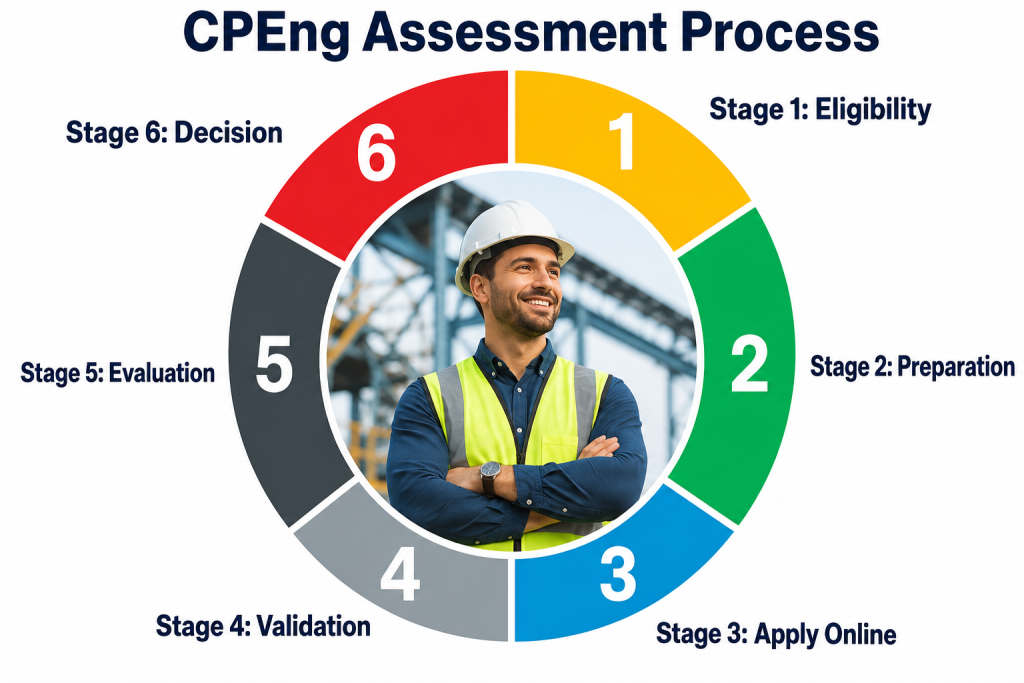
Purpose of Self-Assessment Form to Achieve CPEng Status
Engineering New Zealand’s assessment panels evaluate what you present. Your self-assessment provides context for your work samples and CV, demonstrating how your experience meets the minimum standard for a reasonable professional engineer. The Self- assessment form structures around four competency groups addressing distinct areas of engineering practice. Assessors expect you to address indicators genuinely applicable to your field.
How to Demonstrate 12 Elements of Engineering Competency in Self Assessment Form?
Each group requires approximately 500 words. Reference specific work samples with page numbers. Adopt first-person language exclusively. Use “I,” “me,” and “my” throughout. Assessors need to understand your personal contribution. If you manage projects, explain your approach. If you designed components, describe your process. Begin with your strongest example. Follow with supporting examples demonstrating breadth across technical areas.
1.) Competency Standard Group 1: Engineering knowledge
Competency group one addresses three areas: widely applied good practice, New Zealand-specific good practice, and knowledge currency.
- For widely applied practice, demonstrate your ability to apply engineering principles from first principles. Describe instances where you consulted literature, sought expertise, or worked from mathematical models. Engineers who follow procedures differ from those understanding underlying theory and adapting approaches to novel situations.
- New Zealand-specific knowledge carries particular weight. Demonstrate familiarity with the regulatory environment, applicable standards, and codes of practice. Examples include the Building Code or relevant New Zealand standards. Establish connections to New Zealand context even if your experience extends beyond New Zealand.
- Knowledge currency demands evidence of deliberate professional development. Participation in technical groups, engagement with code changes, conference attendance, or standards involvement demonstrate commitment. Connect these activities to how they influenced your engineering practice.
Competency Standard Group 2:Managing engineering work
Competency group two evaluates your capacity to manage work and exercise sound professional judgment.
- Describe instances where you held responsibility for technical decisions. Explain your decision-making process, alternatives considered, and selection basis. Risk management deserves specific attention. Articulate how you identified risks, assessed magnitude, and implemented mitigation strategies. Comprehensive hazard analysis signals higher competency.
- Describe how you navigated conflicting demands. What principles guided your prioritisation? How did you communicate difficult decisions?
Competency Standard Group 3: Professional acumen
Competency group three examines ethical conduct, societal impacts, and effective communication.
- Ethical conduct requires concrete examples. Perhaps you recommended a more expensive solution due to safety risks. Perhaps you advised clients their approach conflicted with good practice. Specific examples carry far more weight than abstract commitments.
- Describe how you considered long-term impacts of engineering solutions. Did your work involve environmental consequences, community consultation, or engagement with Mana Whenua? Acknowledge your awareness of Te Tiriti o Waitangi principles.
- Communication effectiveness extends beyond technical presentation. Describe how you adapted approaches for different audiences and facilitated understanding among diverse teams.
Competency Standard Group 4:Developing technical solutions
Competency group four addresses developing technical solutions to complex engineering problems.
✔ Begin with problem definition.
- What was the challenge?
- What constraints applied?
✔ Describe your investigation and analysis.
- What information did you gather?
- What techniques did you employ?
Explain how you generated alternative concepts. Evaluate options against requirements. Document detailed design implementation illustrating your reasoning. Include evaluation of outcomes against specifications. Did implementation perform as predicted? How did you address discrepancies?
Common Mistakes to Avoid with your Self-Assessment Form Rejections
Applicants frequently weaken their submissions through preventable errors. The following table outlines critical mistakes and their consequences:
| 🤦♀️ Mistake | 🤦♂️ Problem | ✔ Solution |
| Passive voice constructions | Obscures your personal involvement | Write “I managed the schedule” instead of “project was completed” |
| Vague claims without evidence | Provides no meaningful substantiation | Specifically name projects and describe your responsibilities |
| Failure to reference work samples | Assertions lack supporting documentation | Connect every significant claim to submitted files with page numbers |
| Unclear personal role | Assessors cannot identify your contribution | Explicitly clarify your personal involvement in project outcomes |
| Incoherent application materials | Creates doubt about integrity and competency | Ensure consistency between CV, self-assessment, and work samples |
| Inadequate referee discussion | Weakens validation of claims | Discuss content with your referee beforehand for feedback |
Beyond these structural errors, several substantive mistakes undermine applications:
- Describing entire project outcomes without clarifying your personal role
- Attempting to address every performance indicator rather than selecting relevant ones
- Failure to establish connections between your work and New Zealand engineering context
- Assuming assessors will recognise complexity without explicit statements
- Using industry jargon and acronyms unfamiliar to general engineering audiences
- Including redundant phrasing or background information unrelated to competency standards
- Providing passive descriptions of team achievements instead of personal accomplishments
Ensure coherence across application documents. Your CV establishes work history. Your self-assessment interprets that history against competency standards. Your work samples provide evidence. Internal consistency signals genuine engagement.
Your referee’s signature indicates they have reviewed your self-assessment, confirmed accuracy, and verified work samples support claims. Discuss content with your referee beforehand.
What Tone and Language Apply with CPEng Self-Assessment Form?
✔ Maintain professional, formal tone throughout. Avoid colloquialisms and conversational phrasing. Use sufficient detail for assessors unfamiliar with your industry. Avoid jargon not universally understood.
✔ Explicitly describe complexity. State which complexity characteristics your work exemplifies. Every sentence should contribute meaningfully to demonstrating competency.
✔ Your self-assessment represents your opportunity to speak directly to assessors about your engineering competency. The form signals seriousness of purpose and professional maturity. Engineers investing genuine effort crafting coherent, evidence-based self-assessments produce stronger applications.