Table of Contents
Focusing on exact attention to detail is of utmost importance when preparing your Chartered Institute of Building (CIOB) Professional Review. Candidates who read the official guidance along with the assessment criteria thoroughly, possess a better chance of qualifying during the first time.
However, there are some do’s and don’ts to bear in mind, before you start preparing the CIOB professional review competency report by CDRAustralia.Org Guidance team.
Follow these Do’s and Don’ts when you write your CIOB Professional Review Competency Evidence.
Your submission must emphasize solely on your individual professional experience and direct actions.
Do’s
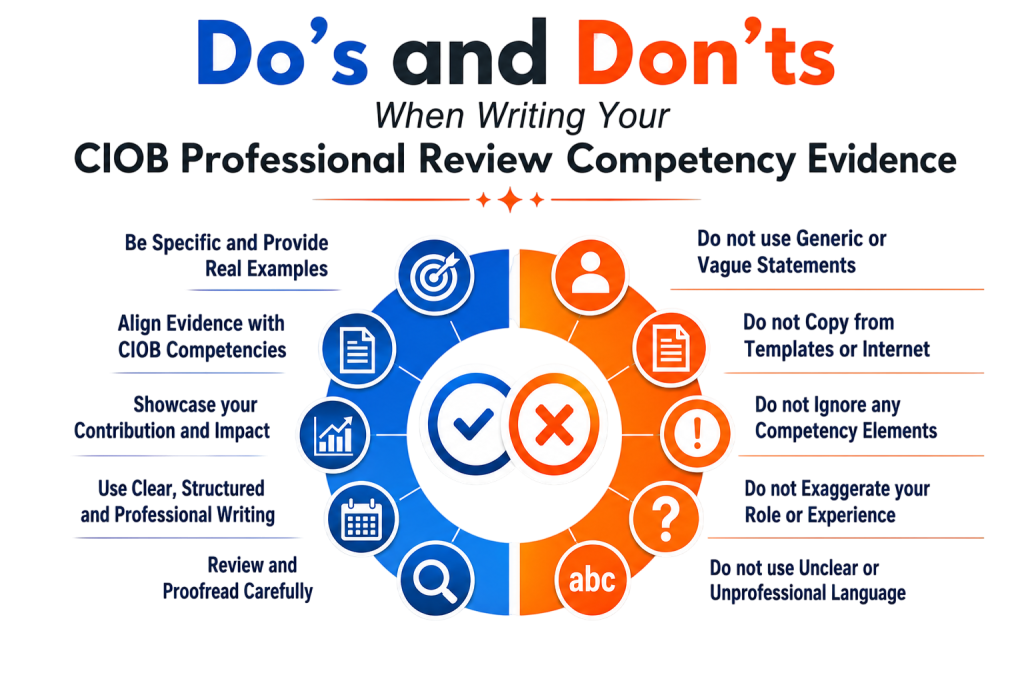
- Before completing the report, go through the Professional Review Guidance and Assessment Criteria for Candidates. This enhances the chances of approval.
- Add one or two clear and detailed examples of competence from your practice. Always use past tense and first-person tonality. It is advisable to use the CARL format-
- Learning: Summarize the learning you achieved from this experience.
- Circumstance: Describe the situation where you had to act on.
- Action: What action did you take and why.
- Result: Analyze your action results or decisions including the strengths and weaknesses.
- When possible, incorporate introspection and assessment into your practice to show how you would approach things differently. If it helps, you can incorporate other people’s perspectives.
- Make the most of the available space by describing and demonstrating your expertise. Assessment is limited to what is visible within the text box. Any text box that has a scroll bar will require you to shorten your response. If the text flows outside of the visible text box area, the PR Team will return the report to you. You must use font size 11.
- Comments that are obvious, such as “Health and safety is important to the organization” or “Planning and organization is crucial for the smooth running…,” should be kept brief. An introduction to a section is beneficial, but if it is used excessively, it begins to sound like generalizations. We are searching for personal examples.
- Be truthful about your accomplishments. Prestigious projects worth millions of pounds are not what the assessor is looking for. They are searching for proof of competence, the capacity to recognize the boundaries of one’s authority and obligations, the capacity to make moral choices, and the dedication to growth and learning.
- Do proofread for grammatical and spelling mistakes. If it is evident that your report has not been proofread, the PR Team will return it.
Don’ts
- Avoid writing “we follow company” or “we do this at.” If you do too much of this, you may not be working independently.
- Don’t include your job description or duties.
- The assessor wants to know about you and your practice, so don’t explain company policies like we do at my company. Policies that guide your practice may be consulted.
- Don’t assume that working on big projects or prestigious locations proves your competence.
- You might be asked about your experience and responsibilities, so don’t embellish or misrepresent them.
- Avoid using bullet points. It implies that you are unable to complete the boxes with two meaningful examples.
- Don’t use acronyms unique to your company without providing the complete title at some point in your report.
- Don’t submit any other documents that aren’t covered in this guidance. They won’t be part of the assessment submission.
- Your documents must be sent to us electronically; do not send them on paper.
- This is a professional report that needs to be completed electronically; do not submit your application handwritten.