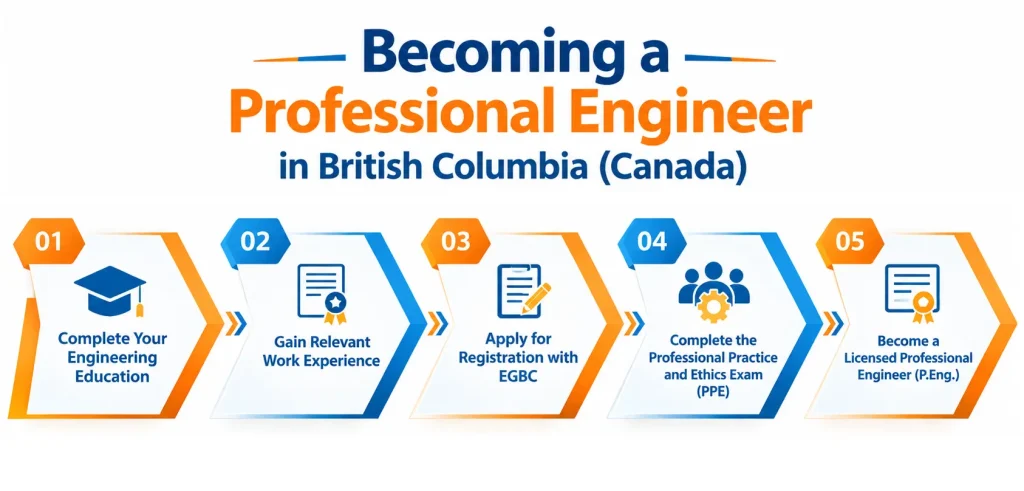
Candidates who want to become a Professional Engineer (P.Eng.) in British Columbia (BC) must register with Engineers and Geoscientists BC (EGBC), the provincial regulatory body. It is essential for them to satisfy academic, experience, legal, ethical, language and character requirements before you can practise engineering under the protected designation.
CDRAustralia.Org have team of well-experienced (P.Eng engineers) and helps candidates to write 34 competencies and assures 100% plagiarism-free work without using AI tools.
Also Read:- EGBC Report Writing Services
Below are the eligibility criteria to become a professional engineer in British Columbia (Canada). Our expert will help you prepare the 34 competencies to a high standard.
Academic Qualifications for P.Eng. Registration
You must hold one of the following:
- A university-level bachelor’s degree in applied science or engineering.
- A four-year, full-time post-secondary degree in geoscience, science or technology.
If your degree is not from an accredited Canadian programme, EGBC may require academic examinations, an interview or additional assessment. Your application may receive academic consideration where your qualification is recognised through an applicable international agreement, or where you hold relevant postgraduate education or supervised experience.
Engineering Experience and Competency Requirements
You must have at least four years of satisfactory engineering experience. Your record must show the practical application of engineering theory, together with knowledge of management, communication and the social effects of engineering work.
EGBC assesses your experience through seven competency areas:
- Technical competence.
- Communication.
- Project and financial management.
- Team effectiveness.
- Professional accountability.
- Social, economic, environmental and sustainability considerations.
- Continuing professional development.
You must complete the Competency Assessment System and provide at least four validators who can confirm your experience. You must demonstrate Canadian environment competencies, including knowledge of Canadian regulations, codes, standards, safety practices, quality control and professional responsibility. This experience may be gained in Canada or overseas.
Up to one year of supervised pre-graduation or co-operative experience may count towards the four-year requirement. Relevant experience gained during postgraduate study may receive credit after assessment.
Legal, Language and Character Requirements
You must complete the following requirements:
| Requirement | What you must provide |
| Legal and ethical knowledge | Pass the National Professional Practice Examination and complete the Professional Engineering and Geoscience Practice in BC Online Seminar |
| English competency | Evidence of suitable oral, written, reading and comprehension skills |
| Good character | Information showing good character and good repute |
| Identity | Certified copies of two valid government-issued identity documents |
EGBC may request an approved English test, such as IELTS, CAEL or the Duolingo English Test, after reviewing your competency submission. You should not arrange a test unless EGBC asks you to do so.
Visa Options for Overseas Engineers
Your immigration status and P.Eng. registration are separate matters. You must hold the appropriate Canadian immigration authorisation to live or work in BC, and you must meet EGBC’s licensing rules before practising regulated engineering.
Common routes include:
- Employer-specific work permit: You may work for the employer, occupation and location listed on your permit. The employer may need a Labour Market Impact Assessment (LMIA), unless the position qualifies for an exemption.
- Study permit: You may complete an eligible Canadian engineering programme and later assess your eligibility for a post-graduation work permit, subject to current federal rules.
- Express Entry: Skilled workers may enter the pool through the Canadian Experience Class, Federal Skilled Worker Program or Federal Skilled Trades Program.
- British Columbia Provincial Nominee routes: A provincial nomination can support permanent residence for eligible skilled workers. An Express Entry-linked nomination provides 600 additional Comprehensive Ranking System points.
- Open work permits: You may qualify through a separate category, such as a spouse or partner-based permit, but eligibility depends on your circumstances and current immigration rules.
A visa or work permit does not grant the right to use the P.Eng. designation. You must complete EGBC registration before offering regulated professional engineering practice.
Apply for Registration
You apply through EGBC’s online portal and submit your application, certified identification, official transcripts and any additional academic documents requested. Non-accredited graduates may need a self-evaluation checklist, course descriptions and postgraduate thesis abstracts. EGBC states that application review may take approximately six months after receiving all required documents.
Check Your Pathway Before Applying
If you meet the academic requirements but lack four years of experience, Engineer-in-Training registration may be suitable. If you hold a non-engineering academic background and at least eight years in a defined area of reserved practice, the Professional Licensee Engineering pathway may apply instead.
Also Read:- How To Become A Professional Engineer (P.Eng) in British Columbia?