Chartered Institution of Building Services Engineers or CIBSE membership is the prime professional body, responsible for building services engineering globally. It provides a clear pathway for building services engineers to professional recognition. They offer an option to pair the candidate’s grade to an Engineering Council UK (ECUK) registration title such as IEng, EngTech or CEng.
In this guide, you will find all the detailed information on membership grades, required documents, application routes, the Engineering Practice Report, sponsor role, interview procedure, timelines, fees and ongoing obligations. It will help you understand what to expect right from the start till the end.
Engineering Council (EC) UK CIBSE Overview
The Chartered Institution of Building Services (CIBSE) Engineers is among the leading professional bodies, recognized for building services engineering. It operates a global network that offers technical guidance along with professional support as well as career development resources.
CIBSE is licensed by the Engineering Council UK (ECUK) in order to assess candidates while awarding them with professional registration titles. It acts as an internationally recognized benchmark of commitment, competence and skill. While you are applying through CIBSE, you must align your corporate membership grade with an ECUK title. This ensures your academic background as well as practical expertise are being verified against strict global standards.
CIBSE Membership Grades and ECUK Alignment
CIBSE is known to offer non-corporate or entry-level memberships and corporate grades that bear designatory letters along with ECUK registration eligibility. So, you must target a corporate grade if you are looking forward to using post-nominals and holding a registered title.
Entry-level grades
- Student Membership: It is ideal for part-time or full-time STEM students. This is generally free for full-time students while providing access to foundation technical publications.
- Graduate Membership: This is for candidates who have completed a relevant STEM degree within the past 5 years. It provides a significant transitional grade to gather early work experience.
- Affiliate Membership: It is open to anyone who is working in or alongside the built environment and there are no strict entry criteria. It offers a base to access knowledge networks.
Corporate grades and ECUK titles
| CIBSE grade | Designatory letters | ECUK alignment | Typical profile |
| Licentiate | LCIBSE | Engineering Technician (EngTech) | Technicians applying practical, creative techniques to building services technology. |
| Associate | ACIBSE | Incorporated Engineer (IEng) | Engineer or management-level professionals who master and apply current and emerging technology. |
| Member | MCIBSE | Chartered Engineer (CEng) or IEng | Senior professionals in technical and commercial leadership roles. |
| Fellow | FCIBSE | Chartered Engineer (CEng) | Senior engineers with significant individual contribution and industry leadership. |
Pathways to Registration: Academic vs Experience Routes
When pairing your CIBSE application with ECUK registration, you choose a pathway based on your academic background.
Academic Route (standard)
This route applies if your degree is accredited by the Engineering Council or covered under international accords.
- For IEng (ACIBSE): an accredited UK Bachelor’s in engineering/technology, or an equivalent under the Sydney Accord.
- For CEng (MCIBSE): an accredited integrated Master’s (MEng), or an accredited Bachelor’s (Hons) plus an appropriate Master’s/EngD, or qualifications recognised via the Washington Accord.
You can verify your degree status via the CIBSE academic database; if fully accredited, you proceed to compiling written work experience and preparing for professional review.
Experience Route (alternative)
If your degrees are non-accredited, international outside certain accords or if you do not have formal high-level qualifications, you can still obtain full membership and registration. The Experience Route instead emphasizes demonstrating that your practical career has supplied an equivalent foundation of engineering knowledge. Under this route, you submit an Experience Template to demonstrate the application of workplace experience to command of fundamental theories (e.g. fluid dynamics, thermodynamics, electrical systems or mathematical analysis). This is reviewed by CIBSE to ensure that you have a technical understanding at benchmark level before you are taken through the standard review stages.
The Application Pack: Mandatory Documentation
The initial phase uses an online portal where distinct documents must be compiled and uploaded separately. Each piece plays an intentional role during panel reviews.
- Qualification certificates and transcripts: official scans of all degrees, diplomas, or certificates; non-English documents require certified English translations.
- Updated CV: a detailed, chronological CV outlining employment history, project histories, and clear progression of engineering duties.
- Organisational chart: a clear diagram of your current employer’s structure, marking your name, position, reporting lines, and who reports to you.
- Development Action Plan (DAP): a concise one-page A4 document outlining short-, medium-, and long-term professional development goals.
- Application and interview fees: paid online at submission; current entry-level members typically receive a waiver on standard application handling fees, leaving primary evaluation and interview costs active.
For MCIBSE CEng applications specifically, you also prepare a 4,000-5,000 word Engineering Practice Report, a CEng Experience Template (if applicable), a sponsor-completed Demonstration of Competences statement, sponsor contact details, your ID, and a debit/credit card for fees.
The Engineering Practice Report (EPR) Competence Writing Criteria and Tips to Avoid Rejections
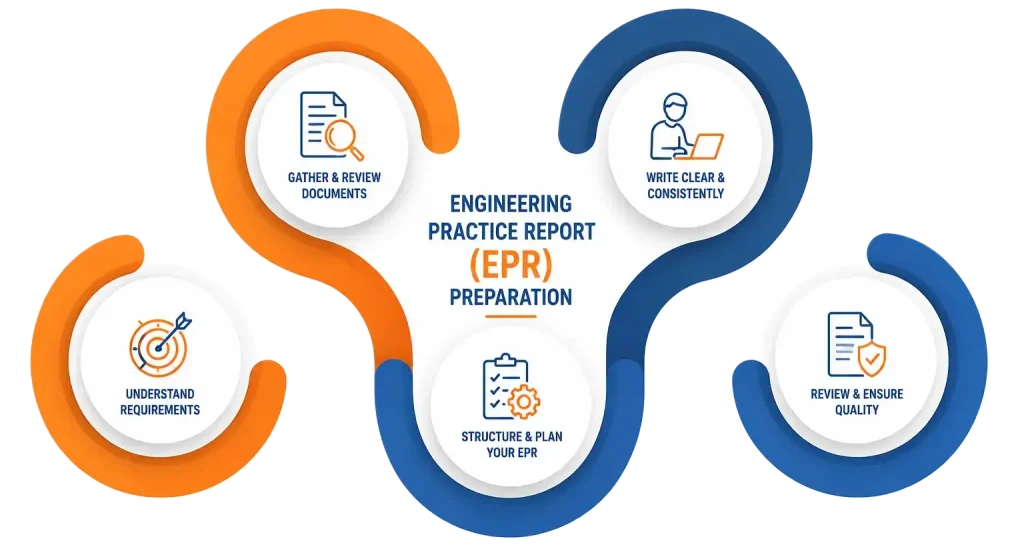
The Engineering Practice Report (EPR) is the core of a corporate application. It links your career history directly to the Engineering Council’s UK-SPEC competence benchmarks. The report is expected to be 1,500-2,000 words for LCIBSE (EngTech) and 4,000-5,000 words for ACIBSE (IEng), MCIBSE (CEng) and FCIBSE.
Use the first person (“I designed,” “I analysed,” “I managed”) to focus on what you did rather than what the team did in general.
The report must address the 17 core competencies mandated by UK-SPEC, grouped into five sections:
1.) Section A – Optimisation of Engineering Technology:
how you use theoretical and practical knowledge to develop or optimise technology, overcome technical challenges, or introduce innovative designs.
2.) Section B – Application of Theoretical and Practical Methods: your analytical workflow, including data analysis, engineering calculations, equipment specification, surveys, or troubleshooting during design and installation.
3.) Section C – Technical and Commercial Leadership: management responsibilities, directing project teams, budgeting resources, managing client relationships, procurement, or continuous improvement strategies.
4.) Section D – Communication and Interpersonal Skills: communication with clients, authorities, site staff, and external design teams; writing technical letters, presenting reports, negotiating terms, and leading multidisciplinary discussions.
5.) Section E – Personal Commitment to Professional Standards: alignment with ethical, legal, and safety standards; adherence to the CIBSE Code of Conduct, sustainability practices, occupational health and safety laws, and structured professional development.
The Role of the Sponsor
For all corporate membership applications, a competent sponsor is required to check your paperwork, read your EPR and complete a specialized Demonstration of Competences statement.
Sponsor Requirements
- The sponsor must have known you in a professional capacity for at least one full year.
- They must hold a registered professional engineering status equal to or higher than the grade you are applying for (for example, if you apply for MCIBSE CEng, your sponsor should be a registered CEng with CIBSE or another recognised UK institution).
- The sponsor must counter-sign copies of your academic diplomas and transcripts to verify authenticity.
During the online process, you submit your sponsor’s contact information; CIBSE then contacts them directly to collect formal evaluations and competence questionnaires.
The Professional Review Interview (PRI)
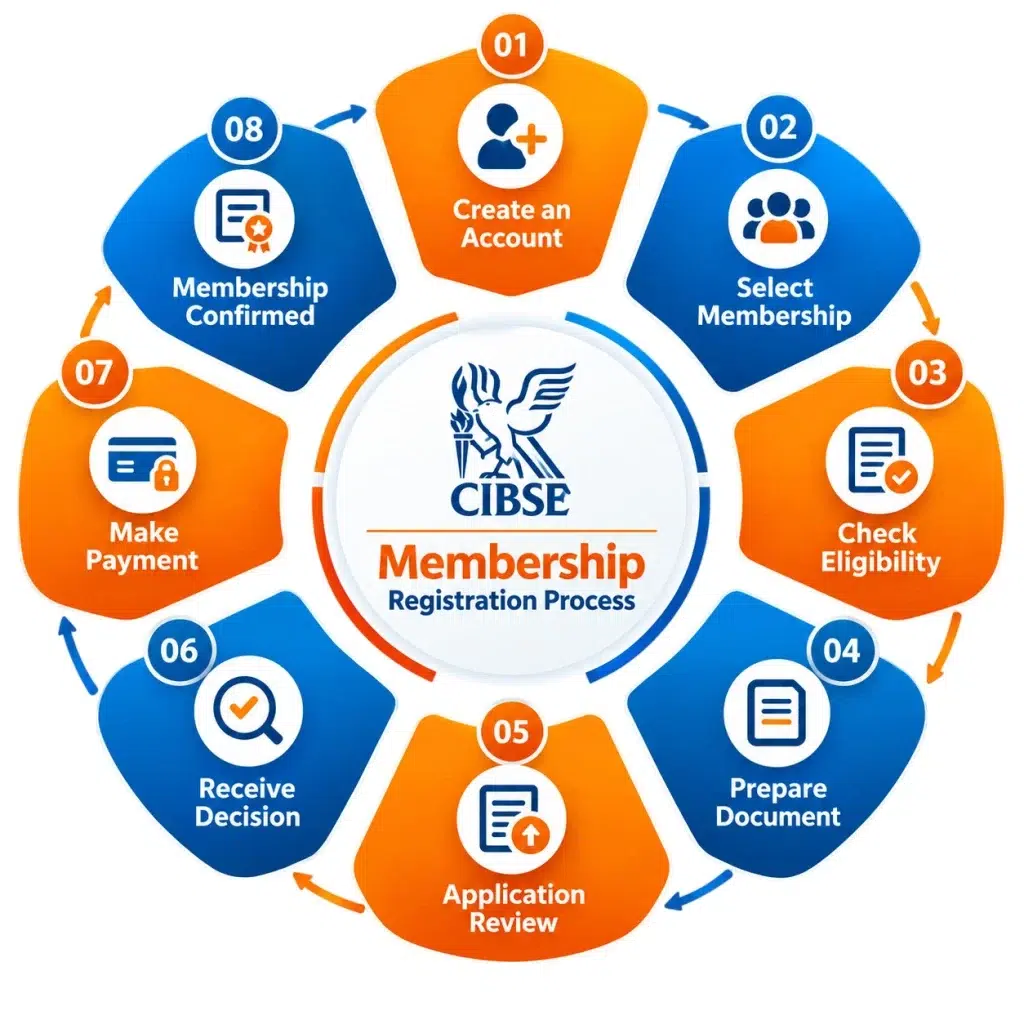
The CIBSE Membership Panel will review your written application, qualifications and sponsor information to check they meet baseline requirements. If they do, you will be invited to a Professional Review Interview (PRI), which is typically carried out remotely using platforms like Microsoft Teams. The process starts with written submission then a panel pre-screens then an invitation to interview then review by the registration panel and notification.
The interview is conducted by two experienced, trained CIBSE volunteer interviewers and consists of two primary components:
- Presentation: a strict 15-minute presentation summarising your career highlights and detailing one or two key engineering projects that demonstrate your competencies.
- Question and Answer session: roughly 45–60 minutes of detailed questions testing problem-solving capabilities, technical choices, risk management skills, and ethical judgments.
The interview gives you an opportunity to verbally elaborate on your EPR and demonstrate that your daily work matches the depth expected of an ECUK professional.
Professional Registration Timeline and Fees
UK applications have closing dates throughout the year. International applications are considered on a rolling basis. Once the interview has been completed, interviewers forward their recommendations to the central CIBSE Membership and Registration Panel for final approval. The whole process from submission to the final decision usually takes about three to five months.
When you do, you pay entrance fees and annual subscription fees to the Engineering Council register. So, on top of your usual CIBSE membership fees, you have to pay annual retention fees to maintain your professional letters. The annual subscription cost of MCIBSE is £344.
Maintaining Status: CPD and Professional Ethics
Earning a membership along with registration is a continuous procedure. It necessitates maintaining your professional position. All the corporate members are required to participate in structured Continuing Professional Development or CPD while also adhering to professional ethics.
CPD Mandates
It is important to track and document your education as well as professional development activities annually. This shall include-
- Technical courses
- CIBSE society events
- Reading building journals
- Mentoring junior engineers
CIBSE also conducts regular random audits of member CPD records in order to verify ongoing engineering compliance.
Ethical Commitment
It is a must for every member to practice completely in accordance to the CIBSE Code of Conduct. All this, while prioritizing public safety, following sustainable environmental practices, minimizing risks and maintaining professional integrity across every project delivery phases.
Next Steps and Applicant Support
There could be instances when a candidate feels unsure which membership suits their current stage. In that case, CIBSE also offers an interactive Membership Finder to recommend your most suitable grade.
To get additional support with the application, the candidate may also explore applicant support services, sample reports, guidance documents etc., that are available on the CIBSE official site. In case you have further queries during the procedure, the membership team can be contact for assistance.