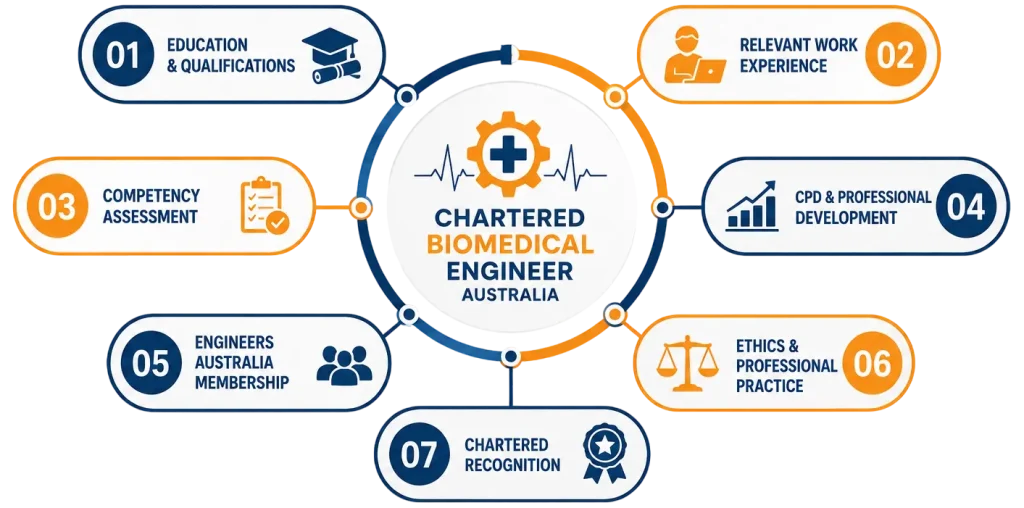
Becoming a Chartered Biomedical Engineer in Australia means demonstrating sustained, high-level practice across the 16 Elements of Competency set by Engineers Australia (EA), then completing the Chartered pathway that best fits your experience. Biomedical engineering applies engineering design and problem-solving to medicine and biology, covering activities such as design, development, evaluation, installation, maintenance, operation and research on biomedical devices, equipment, facilities and prosthetics.
CDRAustralia.Org is a trusted agency that helps biomedical professionals achieve EA credential status. Our experienced writers provide plagiarism-free content and do not use AI-generated text.
What Chartered Status Means for Biomedical Engineers in Australia?
Acquiring the Chartered Credential Status refers to a formal recognition you receive under national standards of competence, ethics and ongoing professional development. This signals capability in clinical environments, regulatory contexts and med-tech development for biomedical engineers. It also supports senior, lead and consulting roles across manufacturers, hospitals and research organisations.
16 Elements of Competency for Biomedical Chartered Engineer
There are 16 Elements of Competency against which Engineers Australia assesses the applicants. These elements are grouped into 4 domains.
Personal and Professional Responsibility
- Ethical conduct and professional accountability
- Community and societal responsibilities, including risk management
- Commitment to ongoing learning and CPD
Workplace and Business Skills
- Communication and teamwork in multidisciplinary settings
- Planning, resource management and project delivery
- Understanding of legal, regulatory and commercial contexts
Technical and Engineering Application
- Application of biomedical engineering knowledge and methods
- Problem analysis, design, development and evaluation of solutions
- Use of tools, standards and quality processes relevant to medical devices and clinical systems
Leadership and Management
- Leading technical work and mentoring others
- Managing change, innovation and continuous improvement
- Strategic thinking aligned to organisational and patient-safety outcomes
In practice, your evidence will come from projects involving device design, clinical installations, maintenance programs, risk assessments, regulatory submissions, research studies and cross-functional collaborations with clinicians and manufacturers.
Various Pathways to Chartered Status with Engineers Australia
Engineers Australia offers several Chartered pathways. Most biomedical engineers pursue Chartered via Industry Review, which suits professionals with around five years of relevant experience.
Industry Review – for engineers with 4 to 5+ years of relevant practice; includes self-assessment, employer review and evidence submission.
Defence – for eligible Australian Defence Force engineers with recent Navy qualifications.
Interview – typically for very experienced engineers (15+ years).
Academics – for those with significant tertiary teaching experience in EA-recognised programs.
If your qualification is not from a Washington, Sydney or Dublin Accord country, you may need to complete a Stage 1 Competency Demonstration Report (CDR) before applying for Chartered status.
Your Roadmap to Earning Biomedical Chartered Credentials with EA: A Step-by-Step Guide
Self-assessment against the 16 Elements
Rate yourself as Developing, Functional, Proficient or Advanced for each element. You must be at least “Functional” across all 16 to proceed.
Industry Review
Nominate an Industry Reviewer (an EA member or engineering team member with 7+ years’ experience) to validate your self-ratings with factual examples from your work.
Enrol for Chartered
Once rated Functional or above on all 16 elements, enrol via the EA portal. You will need identity documents, a detailed CV, a CPD record and payment of fees. You must be an EA member and have at least five years of engineering experience.
Prepare and Submit Chartered Evidence
Use EA’s evidence matrix to compile evidence mapped to the 16 Elements. Common items include-
- CPD log
- Detailed CV
- Industry Review statements
- Project artefacts
- Professional Interview
Assessors will verify the evidence and enquire about your reasoning.
Chartered Decision
Once the evidence and interview meet the panel requirements, you will receive the Chartered Status in your practice area with international recognition under the mutual recognition arrangements of Engineers Australia.
Practical Examples of Mapping Biomedical Work to the 16 Elements
The evidence should sound responsible and impactful. Here are some examples of how biomedical activities meet competency expectations.
| Biomedical Activity | How it maps to the 16 Elements (illustrative) |
| Designing a patient monitor interface | Technical application; problem analysis; design and evaluation; risk management; communication with clinicians; regulatory awareness |
| Installing and commissioning imaging equipment in a hospital | Planning and resource management; teamwork; safety and risk; quality processes; documentation and handover |
| Leading a maintenance program for life-support devices | Professional responsibility; legal/regulatory compliance; leadership; continuous improvement; CPD through standards updates |
| Developing a prosthetic component using FEA and bench testing | Engineering knowledge; tool use; evaluation; innovation; ethical considerations around patient outcomes |
| Conducting a post-market surveillance study | Data analysis; reporting; communication; societal responsibility; commitment to learning and evidence-based practice |
Use real projects where you made decisions, managed risk and delivered outcomes that affected patient care or device performance.
What Assessors Look in Biomedical Evidence?
Assessors focus on depth, not volume. They want to see that you consistently operate at a professional level across the 16 Elements, especially where patient safety and regulatory compliance are involved.
- Clear description of your role and decisions (not just team activities)
- Evidence of risk identification, mitigation and verification
- Alignment with standards, policies and clinical governance
- Reflection on outcomes and lessons learned, feeding into CPD
Next Steps After Chartered Status
Once you have earned the Chartered status, maintain it through ongoing CPD. Adhere to the Code of Ethics and engagement with your engineering community. It will support progression into lead clinical engineering roles, senior positions in med-tech development and consulting and regulatory as well as quality leadership.
Final Checklist Before You Apply
- Meet the baseline including EA membership, equivalent to five years of experience and functional or above on all 16 elements
- Choose an eligible industry reviewer and ensure to complete the review
- Create an evidence-based portfolio which maps it directly to each element with biomedical examples
- Prepare for an ethical and technical interview that focuses on your judgements and outcomes
Precisely following this pathway along with evidence rooted in real biomedical practice, it will position you to achieve a Chartered status. You will be recognised as a senior professional in the health-technology sector in Australia.